
Crazy Time Live Casino Game Show in the UK
 Available in GB
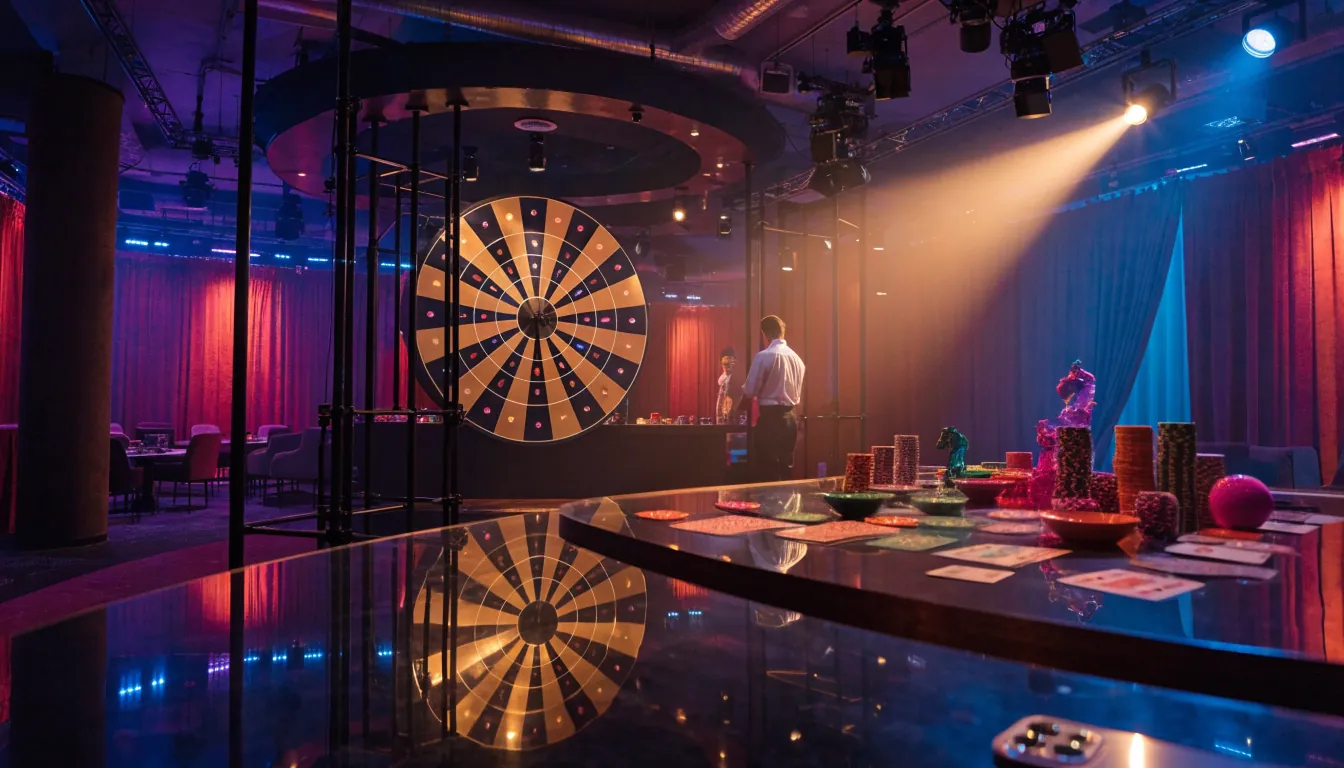
See how streamed studio play and on-screen betting work, alongside practical checks for live tables, licensing and casino offers.
How Crazy Time Fits into Online Live Casino Play
Crazy Time sits in a wider online casino category built around live, streamed play. The important distinction is the setup: gameplay takes place in a studio with a human dealer, while the player follows the broadcast and submits bets through controls on the screen. The casino is online, but the activity being shown is not generated solely as a sequence of computer-produced images.
That arrangement changes what “playing online” means. In a conventional digital game, the screen presents a game whose outcomes are handled by software. In a live dealer game, the screen carries a real-time studio feed alongside an interface for betting. The broadcast and the betting controls serve different purposes: one shows the live activity, and the other sends the player’s selections to the game.
I have found that this distinction is easy to miss in promotional descriptions. “Live” can sound like a decorative label, when it describes the central part of the format: a human dealer is present in the studio, and the gameplay is streamed as it happens. The interface does not turn the studio into a physical casino visit. It makes participation possible remotely.
When looking for a UK casino option related to Crazy Time in 2026, it is useful to check what is known about withdrawals before choosing where to play. The verdicts below stick to the available payout-speed information.
1. BeOnBet
Payout speed: 1-3 business days
BeOnBet lists a payout speed of 1–3 business days.
2. Jetsetspins
Payout speed: 1-3 business days
Jetsetspins lists a payout speed of 1–3 business days.
3. Amunbet
Payout speed: 1-3 business days
Amunbet lists a payout speed of 1–3 business days.
4. WinBeast
Payout speed: 1-3 business days
WinBeast lists a payout speed of 1–3 business days.
5. Dieselwin
Payout speed: 1-3 business days
Dieselwin lists a payout speed of 1–3 business days.
6. Chanze
Payout speed: 1-3 business days
Chanze lists a payout speed of 1–3 business days.
7. Revery Play
Payout speed: 1-3 business days
Revery Play lists a payout speed of 1–3 business days.
8. Britsino
Payout speed: 1-3 business days
Britsino lists a payout speed of 1–3 business days.
9. SlotoSport
Payout speed: 1-3 business days
SlotoSport lists a payout speed of 1–3 business days.
10. x3bet
Payout speed: 1-3 business days
x3bet lists a payout speed of 1–3 business days.
The screen is therefore doing two jobs at once. It presents the live picture, and it provides the means to place a bet. A player does not need to be in the studio or handle the physical equipment. The relevant actions are made through the online interface while the stream shows the game in progress. That is the basic bridge between a studio game and an online casino account.
For someone looking at Crazy Time online, the useful starting point is this category-level explanation rather than assumptions about particular controls or studio features. The live-casino label describes the general delivery method; it does not, by itself, establish every detail of a named game’s layout, pace, interface or available options. Those details should not be inferred from the words “live casino” alone.
This matters because online casino pages often place different kinds of games under the same broad menu. A live dealer title and a digital game may both be opened from a browser or app, but they do not necessarily share the same underlying format. In the live version, the studio feed is part of the experience. The on-screen betting area is the practical link between the player and that activity.
The distinction is not just visual. A stream can show the dealer and the unfolding gameplay, while the interface communicates the player’s bet. Those elements operate together, but they are not interchangeable: watching the broadcast does not itself place a bet, and a betting control is not the studio action. That separation helps make sense of the online setup without confusing it with a video replay or a purely simulated game.
Mines Casino Game in the UK: Market and Rules
In my experience, the clearest way to assess a live casino description is to separate what the format guarantees from what marketing language merely suggests. The general live dealer model means real-time studio gameplay with a human dealer and an interface for betting. A title’s name or a page’s visual design cannot establish additional features unless those are clearly described. “Immersive” is the sales word; the underlying arrangement is a streamed studio and an online betting interface.
The phrase Crazy Time casino online can refer to the same basic question: how a live casino title is presented through an online service. The answer begins with the delivery format, not with assumptions that the player is physically present or that the game behaves exactly like a digital counterpart. A real-time stream supplies the studio view; the interface supplies the route for placing bets. Those are the core components.
That also explains why the screen may feel like a combination of broadcast and game controls rather than a single, self-contained software window. The player follows what is happening in the studio while using the interface to take part. The online service connects those two elements. The camera view is not the betting mechanism, and the betting panel is not a substitute for the live dealer.
Live Casino Format
Studio stream, human dealer, and on-screen betting controls.
A search for Crazy Time in a UK online casino context is therefore best understood as interest in a named title within the broader live-casino format. The basic setup is straightforward: studio gameplay is streamed in real time, a human dealer is present, and bets are entered through on-screen controls. That description sets a useful boundary. It explains what online live play is, without claiming specific rules, special features or interface details for the named game.
The format in one line: studio stream, human dealer, on-screen betting.
Our top casino picks for the UK
- JetsetspinsBonus: 200% Bonus + 100 Free Spins + Free Royal Wheel · Payout speed: 1-3 business days
- BeOnBetBonus: 100% up to €500 + 100 FS · Payout speed: 1-3 business days
- ZombillionBonus: Welcome Pack 250% up to £4000 + 200 FS · Payout speed: 1-3 business days
- SlotoSportBonus: 500% up to £ 10 200+ 777 FS · Payout speed: 1-3 business days
- Revery PlayBonus: 100% up to€1,000+ 100 FS · Payout speed: 1-3 business days
- DieselwinBonus: Welcome Pack 250% up to £4000 + 200 FS · Payout speed: 1-3 business days
- BritsinoBonus: Welcome Package – Get your £2,200 + 2,000 FS · Payout speed: 1-3 business days
- NightLuckBonus: Welcome Pack + 805% Up To 6400€ + 280 FS · Payout speed: 1-3 business days
- ChanzeBonus: Slots Welcome Bonus #1 200% up to €500 · Payout speed: 1-3 business days
- x3betBonus: Welcome Pack 100% Up to £1.000 + 200 Free Spins · Payout speed: 1-3 business days
The Live Casino Format and What It Means in Practice
Live play changes the rhythm of an online casino session. A digital game can process an action almost immediately; a live table depends on a real sequence of events, with a human dealer and a streamed view of the game. That distinction matters more in practice than the word “live” might suggest. It is not simply a digital game with a more colourful screen. The pace has to accommodate the activity taking place in front of the camera.
That slower rhythm is part of the format, not necessarily a technical fault. A player may need to wait while a round is completed and the next opportunity to act becomes available. The screen is showing a process that unfolds rather than an outcome generated and displayed at once. I have seen the difference framed as “immersive”, which describes the presentation but not the trade-off: the session is less immediate. For anyone used to rapid digital play, that can feel deliberate or frustrating, depending on what they expect.
Chicken Road Casino UK: Game Format and Risks
A stable internet connection is essential because the game reaches the player as a live stream. If the connection falters, the image or sound may pause, become unclear, or fall behind the action. That makes it harder to follow what is happening and to make decisions within the flow of a round. A connection problem does not make the game faster; it interrupts the view of it. The practical point is simple: live play relies on a continuous stream, so connection quality is part of the playing conditions.
The streamed pace also affects how a session feels. There is less control over the interval between rounds than in a digital version, where the software can move directly from one result to the next. In live play, the dealer’s actions and the game’s sequence set the tempo. Waiting is built in. It can make the experience feel closer to watching a table, but it also means that a short session may contain fewer decisions than a player expects from a fast-moving online game.
Minimum bets are another difference. Live games have higher minimum bets than digital versions, so the format can require a larger commitment for each round. That is not a statement about every table or a fixed figure; limits vary. The practical distinction is that the price of taking part may be less flexible than in a digital game. A slower pace and higher minimums together can make casual testing feel less casual, particularly when each round carries a more noticeable stake.
Attention: Live play involves a slower pace and higher minimum bets than digital games, which can make casual testing less flexible.
This is one reason the phrase “Crazy Time live casino” can create the wrong expectation if it is read as a promise of a particular speed or level of control. It points towards a live-casino experience, but the general characteristics of the format do not establish every detail of an individual game. The reliable expectation is broader: live play involves a real-time stream, a human-led sequence and a pace that is slower than digital play. Specific mechanics should be judged from the game’s own information, not inferred from the category name.
In practical terms, live play suits a session where the pauses are acceptable and the stream can be followed without interruption. It is less suited to the assumption that every action will resolve instantly. I would treat the pace and minimum stake as part of the cost of the format, alongside the money placed on the table. Those details are easy to miss in promotional language, where “live” tends to sound like an upgrade without a trade-off. There is a trade-off.
A sensible boundary matters as well. Setting a budget before playing gives the session a stopping point, rather than allowing a slow sequence of rounds to blur into an open-ended commitment. Live casino play is entertainment, not gambling advice, and neither the streamed presentation nor the presence of a dealer changes the financial risk. The format can make a game feel more social and immediate, but the stream itself does not improve the chance of an outcome.
Live Dream Catcher Casino UK: Format and Checks
The useful test is whether the pace, connection demands and table minimums fit the kind of session intended. Those are practical conditions, not decorative features. If they do not fit, the live format may be the wrong choice, even when the game’s presentation looks appealing.
Casino Sites: Licensing Before Interface
When comparing sites that offer Crazy Time, the first distinction is not between polished and plain interfaces. It is whether the operator holds the licence required to offer live-dealer casino games in the UK. A live casino is legal here when the operator has a UK Gambling Commission licence. Without that condition, a convincing lobby, a familiar game title or a prominent “welcome” message does not make the service a lawful UK option.
I have seen how easily presentation can lead the decision. A site may make its live games prominent, arrange casino scores or game information neatly, and put bonus language close to the play button. Those are interface and marketing choices. They do not establish the operator’s regulatory status. Licensing comes first; the rest is secondary.
That order matters because the licence is not a decorative badge. It is the basic requirement for a live-dealer casino serving the UK market. A site’s own statement about its status should not be treated as a substitute for checking the underlying operator and its licence. The name displayed in a lobby may be a brand, while the legal operator is identified elsewhere in the site’s terms or regulatory information. The distinction is easy to miss when the page is designed to keep attention on games.
Licensing Requirement
An operator must hold a UK Gambling Commission licence to lawfully offer live-dealer casino games in the UK.
What “best” can and cannot mean
People comparing Crazy Time casino sites often want a simple verdict: which one is best, which has the clearest scores, or which offers the most attractive bonus. A ranking can make those questions look settled, but a list without a transparent basis is only presentation. A site should not be treated as suitable for UK play just because it appears near the top of a comparison or has a persuasive interface.
I would separate the decision into two stages. First, establish that the operator has the relevant UK Gambling Commission licence for live casino gambling. Then consider the site’s own terms and the practical details of its offer. Reversing that order gives the marketing material too much influence. An appealing promotion cannot compensate for the absence of the required licence.
The same applies to bonuses attached to a live casino. “For Crazy Time” may sound like a promise that an offer is designed around that game, but the wording alone does not tell the full story. The terms determine what the promotion covers. That is a separate assessment from the operator’s licence, and one should not be used as evidence for the other. Attractive terms do not prove regulatory status. A valid licence does not make every offer worthwhile.
Searches for Crazy Time casino bonuses, live casino scores or a strategy can also blur different questions into one. A score shown on a page, a promotional label and an operator’s legal standing are not equivalent forms of evidence. The first may be information about a game; the second is advertising; the third is a regulatory condition. Keeping those categories separate is more useful than treating a busy page as proof of quality.
Eyecon Slots at UK Casinos: What to Verify
In practice, the licence is the threshold, not a medal. It does not tell the whole story about interface, service or value, and it should not be presented as a guarantee that every feature suits every player. It does answer the prior question: whether the operator has the required UK status to offer live casino gambling here. Once that is clear, comparisons have a proper starting point.
No interface can replace that check. A clean lobby is not a licence.
Where to Play: Check the Live Setup and Connection
When looking for a place to play Crazy Time live in the UK, the useful first check is the live setup itself. A live-dealer game is not simply a digital result displayed with studio-style graphics. Gameplay is streamed in real time from a studio where a human dealer is present, while bets are entered through an on-screen interface. The stream and the betting controls have to work together.
That distinction matters when assessing a page for the Crazy Time casino game. The game name and a wheel image do not, on their own, establish what the playing experience involves. The practical question is whether the page opens a live stream and provides an interface for placing bets during that session. I have learned to separate the presentation from the mechanics: a polished lobby can still leave the important details about the live setup unclear.
Live Setup Check
- Verify the game opens a real-time live stream
- Check that betting controls are clear and functional
- Ensure the internet connection is stable
- Confirm the table minimum bets fit your budget
Connection quality is part of that setup, not a minor technical footnote. Live games require a stable internet connection because the video is arriving in real time while the betting interface is being used. A stream that repeatedly stalls can make the experience difficult to follow, and an interface that responds slowly can interrupt the moment when a decision needs to be made. I would check that the connection remains steady before settling into a session, rather than treating a brief successful load as proof that it will hold.
There is also a difference in pace from digital versions. Live play moves more slowly, and minimum bets are higher. That can change the feel of a session: there is more time between decisions, but the amount required to take part may not suit every budget. “Live” sounds like a purely atmospheric upgrade. In practice, it also changes the rhythm and the cost of participation.
A sensible comparison therefore stays close to the actual playing conditions. Does the page clearly identify the live game? Is the stream visible and easy to follow? Can the betting controls be understood without confusing them with the video? Does the connection remain stable enough to watch the action and use the interface? Those are more useful checks than treating a wheel graphic or a prominent play button as evidence of a good setup.
NetEnt slots at UK online casinos: what is verified
The same approach applies whether the aim is to play Crazy Time or another live casino game: assess the stream, the controls and the pace as one experience. Avoid making a decision based only on promotional wording. If the stream is unstable, or the table’s pace and minimum bet do not fit the intended session, the presentation cannot fix that mismatch.
Before playing, set a budget and keep to it. This is entertainment, not gambling advice, and no live format changes the need to make decisions within a defined limit.
Roulette Rules and Variants at Live Tables
Live dealer roulette makes the difference between a physical game and a computerised one visible. At a live table, a dealer spins a real wheel and a ball settles into one of its numbered pockets. Computerised roulette instead uses a Random Number Generator to determine the result. The betting interface may look similar, but the outcome is produced differently.
The basic rule is straightforward: a bet selects a number, and it wins if the ball lands on that number. The wheel’s pocket determines the result; a previous spin does not change what the next spin can produce. That matters when looking at results or statistics. A record of earlier outcomes describes what has happened, not what a future spin will be.
The wheel variant affects the number of pockets and the odds. European Roulette has one green pocket, marked zero. American Roulette has two: zero and double zero, shown as 0 and 00. The extra pocket changes the chance of a selected number being hit. The stated odds are one in 37 in European Roulette and one in 38 in American Roulette.
European Roulette
Features one green pocket marked zero. The odds for a selected number are one in 37.
American Roulette
Features two green pockets (0 and 00). The odds for a selected number are one in 38.
That difference is easy to overlook when the table layout appears familiar. On an American table, the double zero is an additional possible result; it is not just another label for the single zero. The ball can land there, and that outcome is distinct from landing on 0. In European Roulette, there is no 00 pocket.
I have seen players treat the two versions as interchangeable because the main betting area looks much the same. It is not a harmless detail. The number of pockets changes the underlying odds, even when a chosen number and the visible betting controls appear unchanged. Check which wheel is in use before placing a bet.
This is a rules distinction, not a strategy for predicting results. A run of numbers, a table history or a preferred betting pattern cannot make the ball favour a particular pocket. The physical wheel may make the process feel more tangible than a random-number game, but it does not make outcomes predictable.
Crazy Time is a separate game-show format, not a roulette variant; roulette rules should not be used to interpret its results. The same applies to searches describing it as a slot: that label does not explain the rules of a live roulette table. Keep the games distinct.
Deal or No Deal Casino UK: Offers, Boxes and Free Play
Before play, review the table rules and paytable, and set a budget that remains fixed. This is entertainment, not gambling advice. When the distinction between European and American wheels is clear, the central rule remains simple: the ball lands on a number, and the bet wins only when that number was selected.
Blackjack Mechanics, House Edge and Betting Systems
Blackjack is built around a simple target: finish closer to 21 points than the dealer without going over. A hand above 21 is a bust, so a higher total is not automatically better. The dealer’s hand matters too; the aim is not to reach a particular score in isolation, but to beat that hand under the table’s rules.
At a live table, the game is streamed in real time. A human dealer handles physical cards from a standard deck, while players watch and make their decisions through the on-screen interface. That visibility gives the game a different feel from software dealing cards: the dealer and card handling are part of the live presentation. It does not change the underlying objective, or turn the result into something a player can control.
I have seen “strategy” used as if it meant a way to secure a result. In blackjack, it is more useful to separate decisions made during a hand from staking plans applied to a session. The first concerns how to play the hand within the rules. The second concerns how much to wager and how that amount changes after a win or loss. Neither wording should obscure the central point: blackjack retains a house edge.
Martingale is a familiar example of a staking system. Its basic appeal is that a player raises the next stake after a loss, hoping a later win will recover previous losses. But a sequence of losses can make the required stakes grow, and a later win does not erase the financial risk or remove the game’s house edge. A system can organise a pattern of bets; it cannot make losses impossible.
Do
- Separate hand decisions from session staking plans
- Set a fixed budget before playing
- Recognize that the house edge always remains
Don’t
- Use staking systems to try and erase financial risk
- View a betting pattern as a way to secure a result
- Increase stakes to recover previous losses
That distinction also matters when gambling language crosses between games. A request for a Crazy Time strategy, game history or casino tracker does not describe blackjack mechanics. Nor does a record of previous results provide a reliable way to know what comes next in a separate game: trackers cannot affect future spins or Lightning Numbers. History is a record, not control.
In my experience, the most misleading claim is often the quiet one: that a staking method makes play safer because it looks orderly. It may make the sequence easier to follow, but it does not change the chance built into the game. The table rules still govern how a hand is played, and the house edge remains. No system cancels it.
Blackjack can be entertaining, but it is not a way to make money and this is not gambling advice. A budget set before play is a boundary, not a target to recover after losses. Once it is reached, increasing stakes to get back to an earlier position changes the risk, not the odds. A disciplined plan can limit exposure. It cannot promise a winning session.
Trying a Live Game Without Mistaking It for a Slot Demo
The word “demo” can suggest a simple way to try a game before risking money. In live casino, though, it does not automatically mean the same thing as a slot demo. A streamed table is a real-time studio production: a human dealer runs the game, while players submit bets through an on-screen interface. That is a different arrangement from a simulated slot screen.
Casino dice games in the UK: rules and play
The distinction matters because “live casino demo” can describe several things in casual wording: a preview of the interface, a replay or promotional clip, or access to a table without real-money betting. Those are not interchangeable. A video shows the presentation, but not necessarily how the betting controls work. A table preview may show the layout without letting anyone place a wager. And the label alone does not establish that a no-cost mode exists.
I have seen “free” used as a neat advertising umbrella. It can mean a glimpse, a limited trial, or an offer with separate conditions. The word by itself tells little about what is available. The practical check is what the page actually lets a person do: watch a stream, interact with the controls, or place bets with money. If there is no clear description, it is safer not to treat the label as proof of a playable demo.
A slot demo and a live table also create different expectations. A slot’s demo presentation is a digital game interface; live dealer play depends on a person dealing in a studio and a betting interface connected to that session. Seeing a dealer on screen is not the same as having a free-play version of the full game. Nor does a familiar game-show style guarantee that any particular operator offers a demo mode.
The same caution applies to requests for “tips” or a “top” option. A list of supposedly best choices would need reliable, comparable information about the actual games and their terms. Without that, a ranked label is packaging, not evidence. A tip cannot change how a game works or promise a result. The useful distinction is between understanding the interface and expecting an edge.
Live Casino vs Slot Demos
A slot demo is a digital game interface. A live casino demo may be a preview of the interface, a replay, or a promotional clip, and does not guarantee a no-cost playable mode.
Where a live game can be played for money, it remains gambling, not a harmless preview. Set a budget before starting and keep the purpose clear: entertainment, not income or gambling advice. If a page describes a demo, its terms should make clear whether it is a video, a playable mode, or something else. Small print matters. So does the difference between seeing a game and taking part in one.
Free Play, Free Spins and the Limits of Casino Offers
“Free” can describe more than one thing in a casino promotion, and the distinction matters when the intended game is a live table. Free spins are a slot promotion: they are tied to eligible slot games, rather than being credit that can automatically be used on any casino game. A live game such as Crazy Time is not a slot, so a free-spin balance should not be treated as a way to place bets there.
A specialist review reports that most UK welcome offers are built around free spins on slots and cannot be used at live tables. That is a useful description of the offer format, not a promise about every operator or promotion. The individual terms determine which games qualify. The word “welcome” is not a universal pass across the casino lobby.
This is where a search for a free Crazy Time casino game can meet a different reality from the promotion being advertised. A site may offer slot spins while also providing live casino games, but those are separate parts of the product. Seeing both on one page does not make the spins usable on the live table. Nor does the word “free” by itself establish that a particular live game can be played without staking money.
I have seen promotional wording do a lot of work in very little space. “Free spins” sounds broad until the eligible-games clause narrows it. The practical distinction is simple: the offer is attached to the games named in its terms, not to every game available at the casino. Read the promotion as a specific product, not as general account credit.
Push Gaming Slots at UK Casinos: How to Check
That also helps separate a free-spin offer from a review of a live casino game. Reviews can describe the game or the experience of playing it; they do not turn a slot promotion into access to a live table. A search for free spins connected with Crazy Time may reflect an expectation that the promotion applies to the game, but the offer’s eligibility rules decide whether that is so.
No free label changes the underlying format or guarantees a no-cost way to play. Promotional content is not gambling advice, and any decision to play should remain within a set budget. The terms are the dividing line.
GamStop Searches and the UK Licensing Question
The phrase “not on GamStop” can sound like a meaningful guarantee about where a casino is licensed. It is not. GamStop is a self-exclusion programme; a casino’s claimed relationship to it does not, by itself, establish whether the operator is authorised to offer gambling in the UK.
Regulatory Distinction
GamStop is a self-exclusion programme, whereas the UK Gambling Commission licence is the legal requirement for an operator to serve the UK market.
For a live-dealer casino to operate legally for UK players, the operator must hold a UK Gambling Commission licence. That condition applies whether a site describes itself as part of GamStop or says it is outside the programme. The licensing question and the GamStop question are separate.
I have seen promotional wording blur the two. “Available without GamStop” describes a selling point, not a substitute for regulatory status. A site may be presented as a place to play Crazy Time while its wording puts the emphasis on the self-exclusion programme; the decisive legal condition remains the operator’s UK licence. Without that licence, it is not a legal UK casino. Plain distinction.
This matters because searches for a Crazy Time casino outside GamStop can return language designed to make access sound like the whole issue. It is not. The relevant standard for a legal live-dealer casino in the UK is whether the operator holds the required UK Gambling Commission licence. A mention of the game, a studio brand or a claimed absence from a programme does not answer that question.
The same applies when the wording adds “UK” or the current year. Those labels do not change the licensing requirement. Nor does the phrase “non-GamStop” amount to regulatory approval. The UK market’s legal boundary is set by licensing, not by the wording used to advertise a casino.
I keep those points distinct: GamStop concerns self-exclusion; the UK Gambling Commission licence determines whether an operator may legally serve UK players. That is the central issue behind any claim about a non-GamStop live casino in the UK.
Bonuses, Live-Game Weighting and the Fine Print
A Crazy Time casino bonus can look relevant because it appears beside a live game, but placement is not the same as eligibility. The terms decide which games count, and how much they count, towards a wagering requirement. In the offer language, “casino bonus” can mean a reward that is technically available to an account but does little for someone intending to play live tables.
Live games may contribute only a small share of wagering. One stated example is a 10% weighting: only a limited portion of qualifying live-game stakes would count towards the requirement. The exact treatment depends on the offer terms, so the headline value alone does not show how much activity is required before funds can be withdrawn. A bonus may also exclude particular games altogether. Small print does the work.
The same distinction applies to a Crazy Time welcome bonus or deposit offer. A deposit match can sound flexible, yet the eligible-game list may favour slots rather than live casino games. A specialist review reports that most UK welcome offers are free spins for slots and cannot be used at live tables. That is a description from a review, not a guarantee that every operator’s current promotion follows the same pattern. The promotion’s own terms remain decisive.
“No deposit” is another phrase that needs reading in context. It describes how a promotion is offered, not whether it can be used on a particular live game, whether wagering conditions apply, or whether a resulting balance is withdrawable. Those details belong in the terms, not the banner. A Crazy Time casino bonus in the UK should therefore be judged by its eligible games, live-game weighting and withdrawal conditions, rather than by the advertised amount alone.
I have seen the headline do the selling and the weighting do the limiting. Before opting in, check the wagering requirements, game weighting and maximum bet conditions stated in the offer. Set a budget before playing, and do not treat a bonus as a way to improve the underlying odds. This content is for entertainment purposes only, not gambling advice.
How do you play live roulette?
You place a bet through the on-screen interface while a live dealer spins a physical wheel. You win if the ball lands on a number you selected.
What are the different types of roulette you can play with a live dealer?
European Roulette has one green pocket, 0, while American Roulette has two, 0 and 00. French Roulette is another type; on an even-money bet, a ball landing on zero means you lose only half your stake.
Which single rule has the biggest effect on house edge?
In French Roulette, the rule that an even-money bet loses only half when the ball lands on zero reduces the house edge on those bets.
SpinDog Games
UK Gambling Casino Sites and Slots: What to Check
Learn how UKGC licensing, slot return figures, bonus wagering and withdrawal terms affect a casino site's value beyond its headline offer.
Slingo Casinos UK: Availability and Rules
Learn how UK slot rules, title-level RTP checks and casino licensing relate to Slingo-style play; casino listings alone do not confirm game availability.
Amatic Slots at UK Casinos: Listings and Terms Explained
Learn how Amatic slots appear in UK casino lobbies, how fixed paylines work, and why game listings, RTP versions and bonus terms can differ.
High-Volatility Slots in the UK: What to Expect
Learn how volatility affects win frequency and size, how it differs from RTP, and what to consider when choosing a game for a session.
Published by the SpinDog UK Guide team.