
Fruit Machine Slots UK: How Online Games Work
 Available in GB
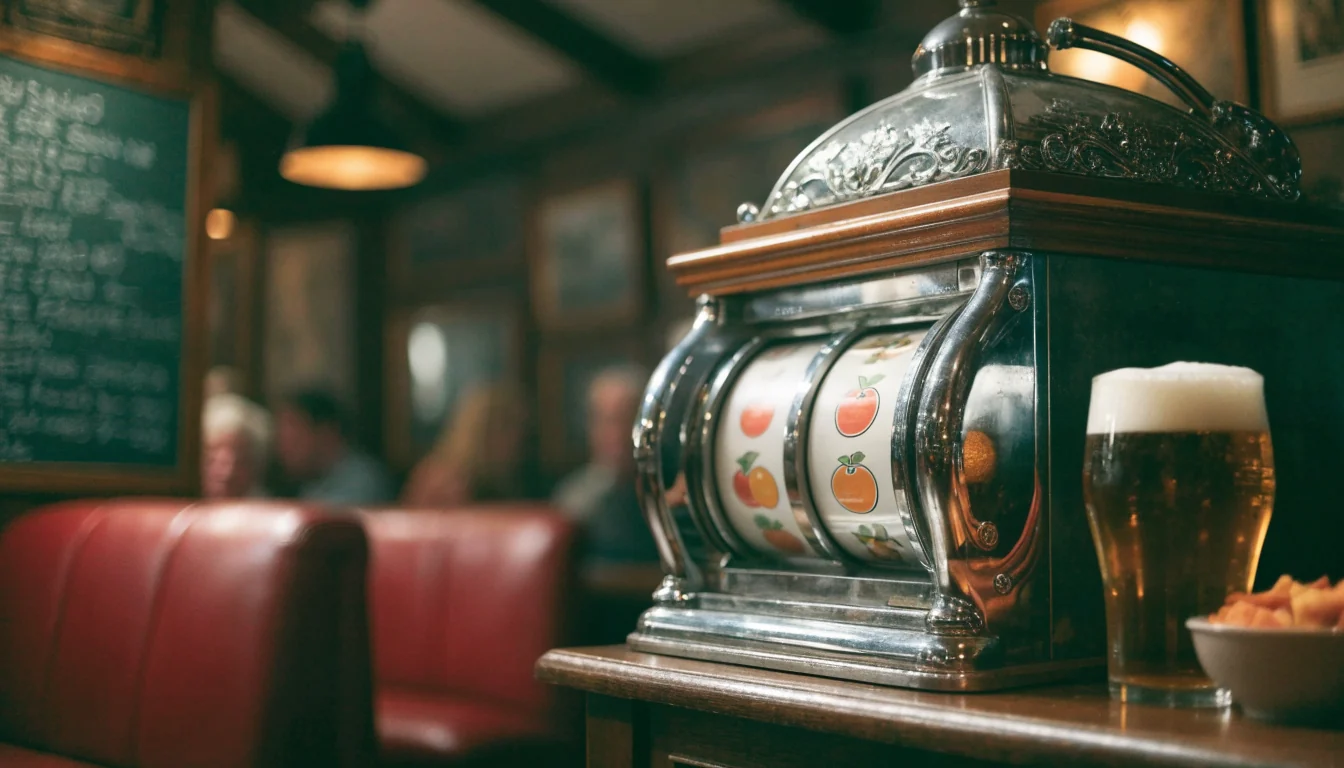
Online fruit slots echo the look of pub machines, but digital outcomes, paytables and demo play each need to be understood on their own terms.
How Online Fruit Slots Turned the Pub Machine Digital
The pub fruit machine had a simple job: turn a stake into a spin, show the result on reels and, if the symbols matched the game’s rules, award a win. Its digital descendants preserve that recognisable shape, but the mechanism behind the display is different. Online fruit slots use software and a random number generator (RNG) to produce outcomes. The reels are now an image of the result, not physical drums whose movement determines it.
That distinction matters. A familiar sound, a fruit symbol or a reel that appears to stop just short of a line can make an online game feel like a pub machine. The appearance is inherited; the outcome process is digital. Each spin is generated independently, rather than being caused by the previous spin or by a sequence of symbols that a player can read. The animation gives the result a visible form, but it does not turn the game into a physical mechanism.
The transition was not simply a matter of copying a cabinet onto a screen. Digital games could retain the old visual language while changing the number of reels, rows and routes to a win. A fruit-machine theme might therefore sit on a layout much larger than the compact format associated with the traditional pub fruity. The family resemblance is strongest in the symbols and presentation; the underlying game structure can be quite different.
From cabinet to screen
A physical machine has a fixed cabinet and a limited display. An online game can use the screen to show a wider grid, additional symbols and changing visual effects without changing the player’s basic action: select a stake and spin. This gave designers room to build games that still looked recognisable as fruit machines but offered more complex arrangements of symbols and winning patterns.
The screen also makes the reel layout easier to adapt. In a traditional design, the reels and the line across them are the central feature. Modern fruit-machine-style games often use a rectangular grid, with several symbols visible on each reel. Wins may be formed across designated paylines or through other systems that count symbol combinations in a different way. The visual arrangement remains familiar enough to signal “fruit machine”; the rules determine whether the game plays like a leaner classic or a more elaborate slot.
Video Slots in the UK: How They Work
The old machine’s presence in pubs and arcades is part of the cultural memory, but it is not a reliable guide to how an online version works. Cabinet mechanics and online software do not share the same outcome process. I have found that this is where the marketing language can blur two separate things: familiar presentation and identical play. A digital game can borrow the first without reproducing the second.
The phrase “same old favourite” is doing work there. It may describe the symbols, sounds or broad theme. It does not establish that the online game has the same layout, rules or payout configuration as a physical machine. Those details belong to the particular game version.
The modern grid
A common modern arrangement uses five reels, with three rows of symbols visible on each. Rather than one central line, the game can offer a set of fixed paylines, with the number varying from title to title. The lines define which symbol positions count and in what order. A matching group can be a win when it appears along one of those routes, while a visually similar group elsewhere on the grid may not count.
This is why a grid should not be read as a simple picture of matching fruit. The payline pattern is part of the game’s rules. Some lines run horizontally; others take angled paths across the reels. The important point is not to memorise a particular shape, but to recognise that the active routes decide how symbol positions are evaluated. A full-looking row does not, by itself, explain what the game counts.
Fixed paylines are one way to organise wins, not the only one. Some fruit-machine-style slots use “243 ways to win”. In that system, matching symbols can form combinations across adjacent reels without being confined to a set of drawn lines. The number describes the possible routes through the reel arrangement; it is not a promise that a spin will produce a win, nor does it mean that every displayed combination pays.
Fruit-machine-style slots may use either fixed paylines or "243 ways to win" systems to determine how symbol combinations are evaluated on the grid.
The difference is practical. A payline game asks whether symbols match along its listed routes. A ways-to-win game counts eligible symbol combinations through the reels according to its rules. Both can use the same broad visual language—fruit symbols, bright colours and familiar cabinet-style presentation—while interpreting the grid differently.
When reel counts change
Some games take the idea of changing combinations further. Megaways titles use a dynamic reel system in which the number of symbols shown on each reel can change from spin to spin. That shifting arrangement can create as many as 117,649 ways to win. The figure describes the maximum number of potential ways in the system, not a number of separate paylines and certainly not a measure of how often a win occurs.
This is a different design choice from a fixed grid. In a fixed layout, the positions and routes remain stable from spin to spin. In a dynamic layout, the visible symbol count changes, so the possible combinations change with it. The reel display may look more active, but the underlying principle remains: the game evaluates the generated result under its own rules.
Large route counts can sound like a simple improvement. They are not. The number of ways is one feature of a game’s structure, not a verdict on its value or likely outcome. A larger number can make the grid more involved to read; it does not make each spin predictable. The number is descriptive. That is all.
Penny Slots in the UK: Stakes, Free Play and Features
What the animation does—and does not—show
An online spin is presented as reels turning and stopping, but the visual sequence is not evidence that the game is waiting to land on a particular symbol. The RNG produces independent outcomes, and the software displays the result through the reel animation. A near miss can look persuasive because the symbols appear in sequence and the eye naturally follows them. It does not mean the next spin is closer to a win.
This is one of the clearest differences between the physical image of a machine and its digital operation. On screen, there may be a pause, a sound cue or a reel that stops after the others. Those details organise the experience; they do not reveal a hidden progression from one result to the next. A previous spin does not make a later one due.
For the same reason, a run of losses is not evidence that a fruit slot is preparing to pay. Nor does a recent win make the next result less likely. The game’s presentation encourages a sense of continuity, but the outcomes are independent. The cabinet used to supply much of the spectacle; the online version can stage that spectacle through animation.
A familiar family, not one fixed format
“Fruit slots” is best understood as a family resemblance, not a single set of rules. Some titles keep to a compact reel arrangement and a small number of features. Others use five reels and several rows, fixed paylines or ways to win, and some adopt dynamic systems such as Megaways. The fruit-machine identity can survive across all of those formats even when the mathematical structure has moved far from the old cabinet.
Fruit Machine Identity
Fruit machine identity is a visual and thematic style that can be applied to many different mathematical structures and digital formats.
That is why the words “fruit machine” can describe both a nostalgic visual style and a modern digital slot. The first points to the game’s heritage; the second tells little about how a particular title counts wins. The layout and its rules do that work. Once those are separated from the imagery, online fruit slots become easier to read: familiar symbols on the surface, software-defined outcomes underneath.
Our top casino picks for the UK
- JetsetspinsBonus: 200% Bonus + 100 Free Spins + Free Royal Wheel · Payout speed: 1-3 business days
- BeOnBetBonus: 100% up to €500 + 100 FS · Payout speed: 1-3 business days
- ZombillionBonus: Welcome Pack 250% up to £4000 + 200 FS · Payout speed: 1-3 business days
- SlotoSportBonus: 500% up to £ 10 200+ 777 FS · Payout speed: 1-3 business days
- Revery PlayBonus: 100% up to€1,000+ 100 FS · Payout speed: 1-3 business days
- DieselwinBonus: Welcome Pack 250% up to £4000 + 200 FS · Payout speed: 1-3 business days
- BritsinoBonus: Welcome Package – Get your £2,200 + 2,000 FS · Payout speed: 1-3 business days
- NightLuckBonus: Welcome Pack + 805% Up To 6400€ + 280 FS · Payout speed: 1-3 business days
- ChanzeBonus: Slots Welcome Bonus #1 200% up to €500 · Payout speed: 1-3 business days
- x3betBonus: Welcome Pack 100% Up to £1.000 + 200 Free Spins · Payout speed: 1-3 business days
What a UK Casino Licence Changes
A fruit slot may look familiar whether it is opened in a pub or through a website, but the legal setting changes when real money is involved. In Great Britain, an online casino serving local customers must hold the relevant operating licence from the UK Gambling Commission. The requirement applies to operators selling into the market, not only to businesses based here. A website’s location does not remove that obligation.
That is the basic distinction behind the phrase “UK casino”: it should mean an operator authorised to offer gambling to people in this market, not simply a site that accepts a UK address or displays familiar fruit machine games. A licence places the operator within the UK regulatory system. It is not a decorative badge, and it is not interchangeable with permission issued elsewhere.
The Gambling Act 2005 governs gambling in England, Wales and Scotland. Northern Ireland has a separate legal position, so the Act should not be described as covering the whole United Kingdom. For online casinos serving customers in Great Britain, the practical point is straightforward: the operator needs the appropriate Gambling Commission licence to offer real-money gambling legally.
NetEnt slots at UK online casinos: what is verified
What the licence tells the player
For someone browsing UK casinos with fruit slots, the licence is a fact about the operator and the conditions under which it offers gambling. It does not tell whether a particular fruit game is enjoyable, whether its features suit a player, or whether a session will end in a win. Those are different questions. A licensed casino remains a gambling business, not a source of income.
The distinction matters because offshore casinos can be accessible to UK residents without being part of the UK Gambling Commission system. Accessibility is not approval. An operator holding a foreign licence does not thereby hold a UK licence, and a supplier’s or platform’s presence in another regulated market does not substitute for the operator’s British authorisation.
The practical consequence is that a site outside the UK system does not provide the same local regulatory protections. UK players using such sites also lose access to protections and routes connected with the UK system, including GAMSTOP and IBAS dispute resolution. There may be risks of games being manipulated or payouts withheld, with no comparable legal recourse. Familiar branding and a polished interface do not change that position.
From the other side of the counter, I have seen how labels do their work. “International” can sound reassuring; in practice, it says nothing by itself about UK authorisation. The relevant question is whether the operator holds a current Gambling Commission licence for the service being offered. The wording is plain. The consequences are not.
Regulatory Risk
Using casinos outside the UK Gambling Commission system means losing local regulatory protections, including access to GAMSTOP and IBAS dispute resolution.
Account tools are part of the setting
Licensing is not only a matter of who may operate. It also frames how gambling is presented and managed on the account. Many UK-licensed operators provide tools such as deposit limits, session-time reminders and reality checks. The exact tools and their operation can differ between sites, so their presence should not be assumed simply because a casino carries fruit slots.
A deposit limit can place a boundary on how much money is paid into an account over the period selected in the operator’s controls. It is a budgeting mechanism, not a prediction of what a game will return. A session reminder interrupts play with information about time spent, while a reality check gives a prompt at set intervals. Some operators’ checks appear every hour; others use a thirty-minute interval. These prompts do not change the game’s random outcomes, and they do not make a long session safer by themselves.
In operational terms, the useful part is that the tools sit alongside the account rather than inside a particular title. A classic fruit machine game and a more elaborate fruit-themed slot can be played under the same account controls. The account is where limits and reminders apply; the game screen is where the reels and features appear. Keeping those functions distinct makes the tools easier to understand.
Amatic Slots at UK Online Casinos: How They Work
A limit is only useful if it reflects a boundary decided before play begins. Treating fruit machine games as entertainment, setting a budget and stopping when it is reached are more meaningful than relying on a reminder to make the decision in the moment. Winnings are not income. A session can end without a return, regardless of the game’s theme or apparent familiarity.
Licence is not a ranking
There is no sound basis for calling one operator the “best” fruit slots casino merely because it is licensed. The licence establishes a legal and regulatory threshold; it is not a verdict on the game library, the account interface or personal preference. Nor does the presence of classic fruit slots prove that all versions of a title are identical across casinos. Those are separate matters from the operator’s authorisation.
For casino fruit slots in the UK, the licence is therefore the starting condition, not a recommendation. A licensed operator belongs within the local regulatory framework; account tools may help make play more visible and bounded; neither fact changes the uncertainty of gambling. That is the distinction worth keeping clear.
What “Best” Means When the Paytable Is the Evidence
When choosing a fruit machine slot site in the UK for 2026, payout timing is one practical detail to check. The entries below note the stated payout speed for each operator.
1. BeOnBet
Payout speed: 1-3 business days
BeOnBet lists a payout speed of 1–3 business days.
2. Jetsetspins
Payout speed: 1-3 business days
Jetsetspins lists a payout speed of 1–3 business days.
3. Amunbet
Payout speed: 1-3 business days
Amunbet lists a payout speed of 1–3 business days.
4. WinBeast
Payout speed: 1-3 business days
WinBeast lists a payout speed of 1–3 business days.
5. Dieselwin
Payout speed: 1-3 business days
Dieselwin lists a payout speed of 1–3 business days.
6. Chanze
Payout speed: 1-3 business days
Chanze lists a payout speed of 1–3 business days.
7. Revery Play
Payout speed: 1-3 business days
Revery Play lists a payout speed of 1–3 business days.
8. Britsino
Payout speed: 1-3 business days
Britsino lists a payout speed of 1–3 business days.
9. SlotoSport
Payout speed: 1-3 business days
SlotoSport lists a payout speed of 1–3 business days.
10. x3bet
Payout speed: 1-3 business days
x3bet lists a payout speed of 1–3 business days.
“Best” is not a property printed on a fruit slot. It is a judgement made from the version available, its published return figure and the rules shown in its paytable. I have seen attractive labels do a lot of work in a game lobby; they do not tell the whole story. The useful evidence is in the game information.
For UK fruit-machine-style slots, the typical published RTP range is 94% to 97%, although some titles sit outside it. RTP is a long-run theoretical measure, not a forecast for a session or a promise about what a particular player will receive. A figure near the top of that range does not make a game a reliable way to win, nor does it establish that its play will suit every preference. It is one comparison point.
The version matters. A specialist review notes that the same title can be offered with different published RTPs, so a figure found elsewhere should not automatically be treated as the figure at a particular casino. The game’s own paytable or help screen is the place to check. If the displayed information does not make the version or its return clear, the comparison is incomplete.
Attention: The same game title can be offered with different published RTPs depending on the casino; always check the game’s own paytable.
That point is easy to miss when a familiar name appears in several listings. A game’s title may stay the same while the available build differs. A review, a provider page or an old screenshot may describe another version. I treat those as clues, not substitutes for the information attached to the game that is actually open.
Read the whole paytable
The RTP figure is compact; the paytable explains the conditions and payouts behind the game. It shows which symbols pay, what combinations count and whether a feature changes how a win is formed. Those details help distinguish two games with similar-looking fruit symbols or the same broad pub-style feel.
A sensible comparison starts with the displayed rules, not the promotional description. Check how the listed combinations work and whether special symbols or features have their own conditions. Then consider whether that structure is the kind of game being sought: a simple line-based experience or something with additional features. A higher RTP alone cannot answer that question.
Nor should a paytable be treated as an outcome diary. It describes the game’s rules; it cannot tell what the next spin will do. Online fruit slots use random number generators, and outcomes are independent. A winning sequence in one session does not show that a later spin is due to pay, while a run of losses does not make a win more likely.
Online Casino Game Shows in the UK: How They Work
I learned to separate the clear figure from the attractive story around it. A banner can call a game “generous”; that is a claim, not a measurement. A published RTP is more useful, but only when it belongs to the specific version and is read as a long-run theoretical statistic. Neither wording nor number predicts a session.
Comparing without a league table
When people look for the best fruit slot games in the UK, a ranked list can imply that one title is objectively superior. The evidence rarely supports that neat conclusion. The paytable lets a player compare documented features and the published return for the version at hand; preference still depends on the game’s layout and mechanics.
I would make a short comparison on three points: the RTP shown in the game, the paytable’s winning combinations, and the features that shape play. That is not a scoring system. It is a way to avoid comparing one version’s published figure with another version’s rules. If one item cannot be verified in the game information, it should not be filled in from guesswork.
The same test applies when comparing fruit slots sites. A site’s catalogue does not establish the RTP of every title it carries, and a provider’s game name does not prove that every version is available there. The evidence sits at title level. Check the live game information, not just a lobby tile or an old description.
Do
- Check the RTP inside the live game
- Review the paytable’s winning combinations
- Verify the version’s specific features
Don’t
- Rely on a general ranked list
- Use a provider page as a substitute for the game screen
- Assume a bonus improves the underlying RTP
Bonuses are a separate decision from game quality. A fruit slots bonus does not improve a game’s underlying RTP, and a promotion should not be used as evidence that one title is better than another. Its terms and eligible games belong to a different comparison. Keep the categories apart.
In practical terms, “best” means the most suitable choice among the versions whose rules and return can actually be checked. It is a narrower claim than advertising suggests, but a more useful one. The paytable cannot predict a result. It can show what is being played.
Real-Money Play Has Hard Limits
Real-money play on fruit machine slots in Great Britain starts with an age and identity check, not with the first spin. A player must be at least 18 and register using an identity that the operator can verify. That check establishes who is opening the account and which age-based stake limit applies. It is part of access to real-money gambling, rather than a game feature or an optional setting.
The per-spin cap depends on age. For players aged 18 to 24, the maximum stake is £2 per spin. For players aged 25 and over, it is £5 per spin. Those figures are ceilings, not suggested stakes, and an operator may set a lower limit. The relevant limit is the amount placed on an individual spin; it does not describe a session budget or how long a balance will last.
Best Online Casinos with No Limits: UK Guide
I have seen stake controls treated in promotional language as though they were a player preference. That misses the point. The cap is a restriction on what the account can stake, not a choice that can be switched off for a particular fruit slot. Operators are required to enforce the applicable maximum at account level and must not permit a player to exceed it.
In practical terms, the account’s verified age determines the ceiling against which a requested stake is checked. A game may display different stake settings, but settings above the account’s permitted amount cannot be used for a real-money spin. Moving to another title does not remove the account-level restriction. Nor does selecting a different bet arrangement make an over-limit stake acceptable. The control has to apply before the wager is accepted.
That is why identity verification matters to the mechanics of staking as well as to registration. Without a verified age, the operator cannot correctly apply the age-based cap. If an account’s details are incomplete or cannot be verified, real-money access may be delayed while checks are carried out. The restriction is not a judgement about the game; it follows from the account information used to determine eligibility.
The rule also changes how a displayed stake should be read. A fruit slot might offer a range of bet choices, but the available interface does not override the legal ceiling. What matters is the amount accepted for the spin on that account. If a lower limit is in place, that is the effective maximum. If the account is subject to the statutory cap, the game cannot be used to get around it.
Stake Limits
In Great Britain, the maximum stake per spin is £2 for players aged 18–24 and £5 for players aged 25 and over.
A specialist review may describe stake caps in terms of what appears on a game screen, but the important control sits at account level: the operator must prevent any spin exceeding the applicable limit. That distinction matters when a game’s controls look different from another title’s. The presentation can vary; the cap does not become optional.
A stake ceiling is not a loss limit. Several permitted spins can still use a balance quickly, and a sequence of outcomes does not turn the next spin into a safer one. I treat the limit as a boundary on each wager, not as a measure of affordable play or a way to manage losses. The distinction is plain. Different jobs.
These requirements concern real-money play. They should not be confused with a game’s displayed bet range or with the rules of a particular fruit machine. The account’s verified age sets the applicable maximum, and the operator has to enforce it before a spin is accepted.
Free Play, Free Spins and What They Actually Test
Free play is a way to get a feel for a fruit machine’s controls and features without staking real money. It can show how a game presents its reels, what happens when a feature starts and how its instructions are worded. That is useful for orientation. It is not a rehearsal of what a real-money session will produce.
The distinction matters because online fruit-machine-style games use random number generators, or RNGs, to determine outcomes. Each spin is independent. A sequence in free play does not establish what will happen in a later session, whether that session is also free or involves a stake. A run of wins is not evidence that a real-money win is due; a run of losses does not mean the game is saving a result for later. The mechanics do not keep a player’s practice history as a prediction.
I have seen “try before you play” used as if it meant a player can test whether a game will pay. The phrase sounds stronger than the activity. Free play tests the interface and gives a view of how features are triggered and resolved. It does not test the chance of a future outcome.
Free play is not a promotional free spin
The two offers can look similar on screen because neither begins with the player choosing a stake for that spin. Their purpose and conditions are different. Free play is a mode for exploring a game without making a real-money stake. Promotional free spins are an offer attached to a real-money account or promotion; they are not simply another name for opening a game in its free-play mode.
That distinction affects what the experience can establish. A free-play session gives no real-money result to withdraw. A promotional spin may generate a result under the promotion’s rules, but the offer’s terms determine how that result is treated. The display of a spin alone does not explain those terms. Eligibility, any restrictions on winnings and other conditions belong to the live offer, not to the game’s general play mode.
Promotional language often compresses these differences into “free”. The label describes the entry point, not necessarily the full conditions attached to the offer. I treat the game and the promotion as separate layers: one governs how the game operates; the other governs the offer.
Difference between Free Play and Free Spins
Free play is a mode for exploring a game’s interface and features without staking money. Promotional free spins are offers attached to real-money accounts with specific terms governing the treatment of any results.
Features can be explored, not forecast
Some online fruit machine games include features beyond the ordinary spin. A specialist review describes features such as free spins and pick-style mini-games among the possibilities, alongside controls such as autoplay or quick spin. Availability depends on the particular title, so these should not be read as a checklist present in every game.
A pick-style mini-game, for instance, can be explored in free play to understand its sequence: a feature opens, the player makes a selection, and the game displays an outcome. That reveals the structure of the interaction, not a dependable method for selecting a better result. The same principle applies to a free-spins round. It may show how the feature looks and what the game says is happening, but it cannot make a later feature more or less likely.
This is where practice has a practical limit. It can prevent confusion about buttons, instructions or the order of a feature. It cannot turn randomness into a pattern. The screen shows an outcome after it has been determined; a choice inside a mini-game does not, by itself, prove that a player has control over the underlying random process.
What free sessions leave unanswered
Free play can also make the pace and presentation easier to judge. A game may include quick-spin controls, autoplay or mobile compatibility, but their presence and operation are title-specific. Seeing a control in action helps explain what it does. It does not indicate how the game will perform with money at stake.
Nor should a free session be treated as a reliable sample of real-money results. The independent outcomes generated by an RNG mean that one session cannot establish the pattern of another. A handful of spins, or a longer run, still describes only the outcomes shown in that session. It does not promise that the same sequence, frequency of features or balance of wins will return.
For me, free play is most useful when its job stays modest: learn the interface, follow the feature instructions and decide whether the game’s pace makes sense. Promotional free spins are a different arrangement, governed by their own terms. Neither should be mistaken for evidence of future returns.
That is the boundary.
Fruit Themes, from Rainbow Riches to Newer Variants
A fruit-machine theme can be less about fruit symbols than the world built around them. Rainbow Riches is a clear British example: its imagery and name carried the feel of a familiar pub fruity into a branded game world, rather than presenting a generic set of reels.
The game first appeared on Barcrest cabinets in British pubs, arcades and betting shops in 2006. It was adapted for online play around 2009, bringing that established identity to a screen. The move mattered because players could recognise the title without needing the physical cabinet beside them. A familiar brand became a way to connect a newer digital format with the social memory of the machine.
That identity has since been extended through named variants, including Rainbow Riches Pick’n’Mix, Rainbow Riches Megaways and Rainbow Riches Freespins. Piles of Cash and Rainbow Reveal sit within the wider family of recognisable fruit-themed titles. The names signal related branding, but they do not establish that the games share the same rules or presentation; each title has its own game information.
Rainbow Riches
An established British brand that brought the feel of pub fruit machines to a digital world.
Pick’n’Mix
A named variant of the Rainbow Riches family with its own game information.
Megaways
A version utilizing a dynamic reel system with up to 117,649 ways to win.
This is the useful distinction when looking at fruit-themed slot games in the UK: theme is a label and a point of recognition, not evidence of how a game behaves. “Classic” can describe an aesthetic as readily as a format. The cabinet history explains why Rainbow Riches feels rooted in British fruit-machine culture; its variants show how that identity can travel across different digital releases.
Brand first. Rules separately.
Traditional Slots: Holds, Nudges and the Reel They Leave Behind
The appeal of a traditional fruit machine is often its spare layout: three reels, one payline and few features competing for attention. That simplicity makes each symbol position easy to read. The line either contains a winning combination under the game’s rules or it does not.
Holds and nudges add choices without turning the game into a skill-based system. A hold keeps a selected reel in place for the next round while the other reels spin again. It can preserve a useful symbol, but it cannot make the remaining reels land where they are wanted. The player is choosing what to keep, not controlling the next result.
A nudge works after a spin. It shifts a reel down by one position, bringing a different symbol into the payline. That can change the visible combination, but the movement is limited to the option the game provides; it is not a way to reorder symbols freely.
The details are title-specific. A game may offer holds, nudges, both or neither, and their availability can depend on conditions set in that game. The rules screen matters: an apparent choice may not be available on every turn.
I have always found these features easier to understand when separated from their theatre. The pause before a held reel spins, or the small shift of a nudge, makes the player feel involved. But neither changes the random process behind outcomes. They add decision points and variation to the experience; they do not make a result more predictable.
Bonus Buy Slots in the UK: Demos and Rules
That is the distinction from larger, feature-heavy formats. Traditional fruit machine games keep the visible action close to the payline, with holds and nudges giving the player something to consider between spins. The extra choice is real. Control over the outcome is not.
A Demo Is a Paytable Check, Not a Promise
A demo of a fruit machine is useful when treated as an inspection of the version on screen, not a preview of what real-money play will return. I use it to locate the game’s rules: which symbols pay, how features are triggered and whether the displayed paytable gives an RTP. That is practical information about the title as presented. It is not evidence that a run of spins predicts future results.
The distinction matters because the same game name does not necessarily mean identical published RTP everywhere. A specialist review may report one version’s figure, while a casino offers a build with a different return setting. The comparison only becomes useful when the paytable or help screen is checked inside the game at that specific casino. A supplier’s title page or an older review is not a substitute for that screen.
A demo can also show how a feature is explained and what symbols or choices appear when it activates. I still read the rules rather than treating a few demo spins as a test of frequency. Random outcomes are independent; a feature appearing quickly in a demo says nothing about when it will appear in later play. Nor does a demo establish that the real-money version is configured identically unless its displayed information confirms the relevant details.
That is the limit of the exercise. It can clarify the rules and identify the published return attached to the version being offered. It cannot promise a result, validate claims about another casino’s build or turn short-term outcomes into a reliable measure of value. A clear paytable is evidence of stated terms. Nothing more.
Can I play fruit slots for real money in the UK?
Yes. You must be 18 or over, verify your identity, and play with an operator licensed by the UK Gambling Commission.
Are there age restrictions to play online fruit machines?
Yes. You must be at least 18 to play real-money fruit slots in the UK.
Can I play fruit machine slots on my mobile phone?
Yes. Online fruit machine games may be compatible with mobile devices.
SpinDog Games
Play'n GO slots at UK online casinos: what to verify
Learn how to check current game listings and slot information, and why a Play'n GO label alone does not confirm availability, features or a full catalogue.
Mega Moolah Casinos in the UK: What to Verify
Learn what can be confirmed about Mega Moolah listings, free play, jackpot claims, UK licensing and bonus terms before choosing a casino.
Amatic Slots at UK Casinos: Listings and Terms Explained
Learn how Amatic slots appear in UK casino lobbies, how fixed paylines work, and why game listings, RTP versions and bonus terms can differ.
JetX Casino Game in the UK: Licensing and Play
Learn why JetX is often listed by offshore casinos, what “slot” labels establish, and why operators taking bets from British residents need a UKGC licence.
Published by the SpinDog UK Guide team.