
SpinDog KYC and Verification: Documents, Payout Checks and Account Risk
 Available in GB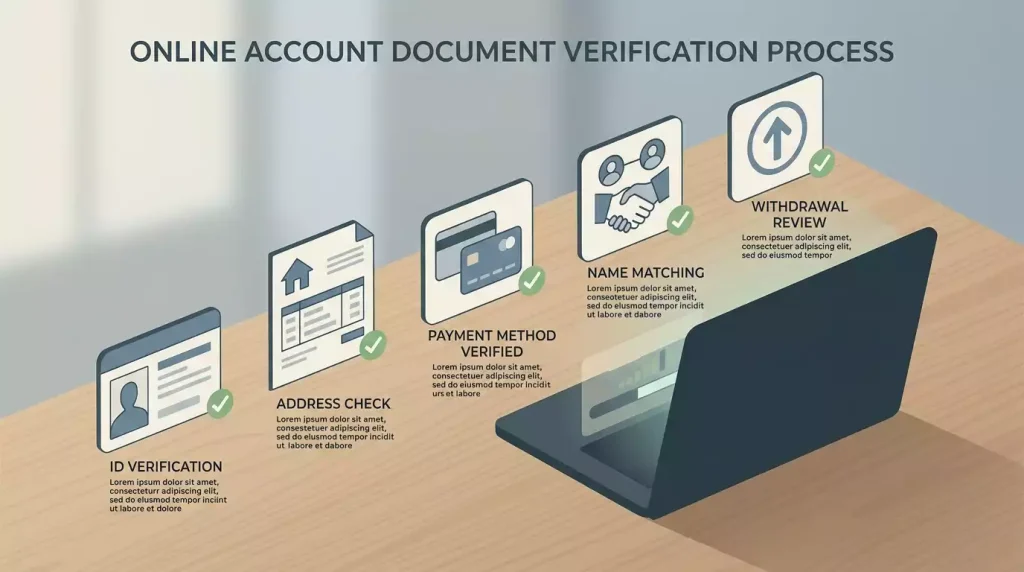
SpinDog should not be described as no-KYC. Its terms reserve the right to check identity before processing payouts and to hold refunds or withdrawals while those checks are completed. Its privacy policy also says documents and proofs may be requested to verify an account, process deposits or withdrawals and carry out anti-fraud checks. That means verification can become important exactly when a player wants to withdraw.
For UK readers, the safest approach is to prepare before depositing: use accurate personal details, keep payment methods in your own name, avoid duplicate accounts, understand bonus locks and check the wider licence and availability caveats. KYC is not just a document upload. It is the point where account details, payment ownership, bonus behaviour and withdrawal rules meet.The short answer on SpinDog verification
Official terms support three important points. First, identity may be checked before payouts. Second, withdrawals may be held while checks are carried out. Third, false personal data can lead to refused withdrawal and account termination. The privacy policy adds that documents may be requested for account verification, deposits, withdrawals and anti-fraud checks.
This is why the account setup guide treats registration details as withdrawal details. If your account name, date of birth, address, payment route or document record cannot be explained later, the risk does not disappear after deposit. It may only appear later during payout review.
What documents may be requested
SpinDog privacy wording gives examples of documents and proofs that may be requested, including passport scans, payment slips and bank statements. The terms also refer to documents such as ID, payment-system details and utility bills, and allow extra verification where submitted documents need additional review.
Those examples should be read as examples, not as a fixed universal list for every player. A specific account may be asked for different evidence depending on the payment method, country, account history, withdrawal size, bonus activity or anti-fraud review. No single document should be treated as a guaranteed solution.
| Verification area | Officially supported examples | Practical preparation |
|---|---|---|
| Identity | Terms refer to ID, and privacy wording gives passport scans as an example. | Use your real legal details and keep an unexpired identity document available. |
| Address | Terms refer to utility bills as a possible document type. | Make sure the address in the account is current and can be supported if requested. |
| Payment ownership | Privacy wording mentions payment slips and bank statements; terms refer to payment-system details. | Deposit and withdraw only through methods registered in your own name. |
| Anti-fraud checks | Privacy wording says proofs may be requested for anti-fraud checks. | Avoid duplicate accounts, false data, third-party payments and forged documents. |
| Language or format issue | Terms allow extra verification where submitted documents need additional review. | Do not assume verification will be instant if documents need extra review. |
How KYC affects withdrawals
Verification becomes most visible at withdrawal because the terms specifically reserve the right to check identity before payouts. They also say refunds or withdrawals may be held for the time needed to check identity. If false personal data is provided, withdrawal can be refused and the account can be terminated.
The withdrawal rules guide explains limits and timing. For KYC, the core point is that payout speed cannot be judged only by a processing timeframe. A bank-transfer window, minimum withdrawal or payment limit does not override identity checks or payment ownership checks.
Before requesting a withdrawal, check whether the account profile is complete, whether your payment method is in your name, whether the balance contains bonus money, whether wagering is complete and whether documents are ready. If any of those answers is unclear, expect a higher chance of delay.
Name mismatch and third-party payment risk
SpinDog terms say the company does not accept third-party payments and that deposits must be made from a bank account, card, e-wallet or other payment method registered in the player’s name. If that condition is violated, the terms describe confiscation of winnings and refund of the original deposit to the payment account owner.
This makes name mismatch one of the most avoidable payout risks. A card in a partner’s name, a shared wallet, a bank account that does not match the player profile or an email attached to someone else’s payment account can all turn into verification friction. The safer rule is simple: account owner, document owner and payment owner should be the same person.
Duplicate accounts and false data
Verification is also where duplicate-account and false-data issues can surface. SpinDog terms and FAQ support a one-account-per-person rule. The terms connect duplicate accounts to suspension or termination, and they say winnings or bonuses obtained through duplicate accounts can be reclaimed.
False registration information and forged documents are also named in the anti-fraud context. That creates a direct connection between account setup and withdrawal outcome. A player who enters incomplete or inaccurate information to get through registration may be creating a payout problem for later.
For the wider account context, read the registration and account rules. This KYC page focuses on what happens when those rules are tested through documents, payments and withdrawals.
Bonus withdrawals and verification
Verification can also intersect with promotional balances. SpinDog bonus terms state that bonus winnings can be withdrawn only after the wagering requirement has been fulfilled. Bonus rules may also include maximum bet limits, expiry rules, cashout caps and verification requirements.
If a withdrawal request includes welcome-offer winnings, it should be checked against both KYC rules and bonus rules. The welcome-offer verification page explains the first-deposit offer separately. The short KYC point is that completing wagering does not remove the need to prove identity or payment ownership if the operator asks.
Document-readiness checklist
- Your full name, date of birth and address in the account are accurate.
- Your identity document is valid and matches the account details.
- Your payment method is registered in your own name.
- You can provide payment evidence if a bank, card, wallet or crypto route is reviewed.
- You have not created a duplicate account to reset access, claim another bonus or work around a limitation.
- You understand whether your balance is real money, bonus money or a mix of both.
- You are not trying to bypass self-exclusion, a banking block, affordability control or local regulation.
UK reader caveats
SpinDog could not be confirmed as a UKGC-licensed operator from the sources reviewed for this guide. UKGC guidance says remote gambling providers need a Commission licence to serve British consumers in England, Scotland and Wales, so local authorisation should be checked separately before relying on account or payout claims.
That caveat matters for KYC because verification is not only about whether an account can upload documents. It is also about what protections, complaint routes, payment controls and regulatory standards apply if something goes wrong. Before sharing documents or building a balance, use the safety and reliability checks as well as this KYC checklist.
GAMSTOP should also be treated as a protection, not as an obstacle. If you are self-excluded or trying to avoid controls, the right decision is not to test another account. The non-GAMSTOP risk guide explains why workaround framing is unsafe.
Frequently asked questions
Does SpinDog require KYC before withdrawals?
The terms reserve the right to check identity before processing payouts and to hold withdrawals while those checks are completed. It should not be treated as a site with no verification.What documents can SpinDog ask for?
Official wording gives examples such as ID, payment-system details, utility bills, passport scans, payment slips and bank statements. The exact request can depend on the account and payment situation.Can a name mismatch block a payout?
It can create serious risk. The terms say third-party payments are not accepted and that payment methods must be registered in the player’s name.Does finishing wagering guarantee a withdrawal?
No. Wagering completion is only one part of the process. Identity checks, payment ownership, account rules, bonus rules and method limits can still matter.
The full picture is in the SpinDog Casino UK review.
Verification matters most at the withdrawal stage.
Prepared by the SpinDog UK Guide editorial staff.