
Hi-Lo Casino UK: Rules, Variants and Strategy
 Available in GB
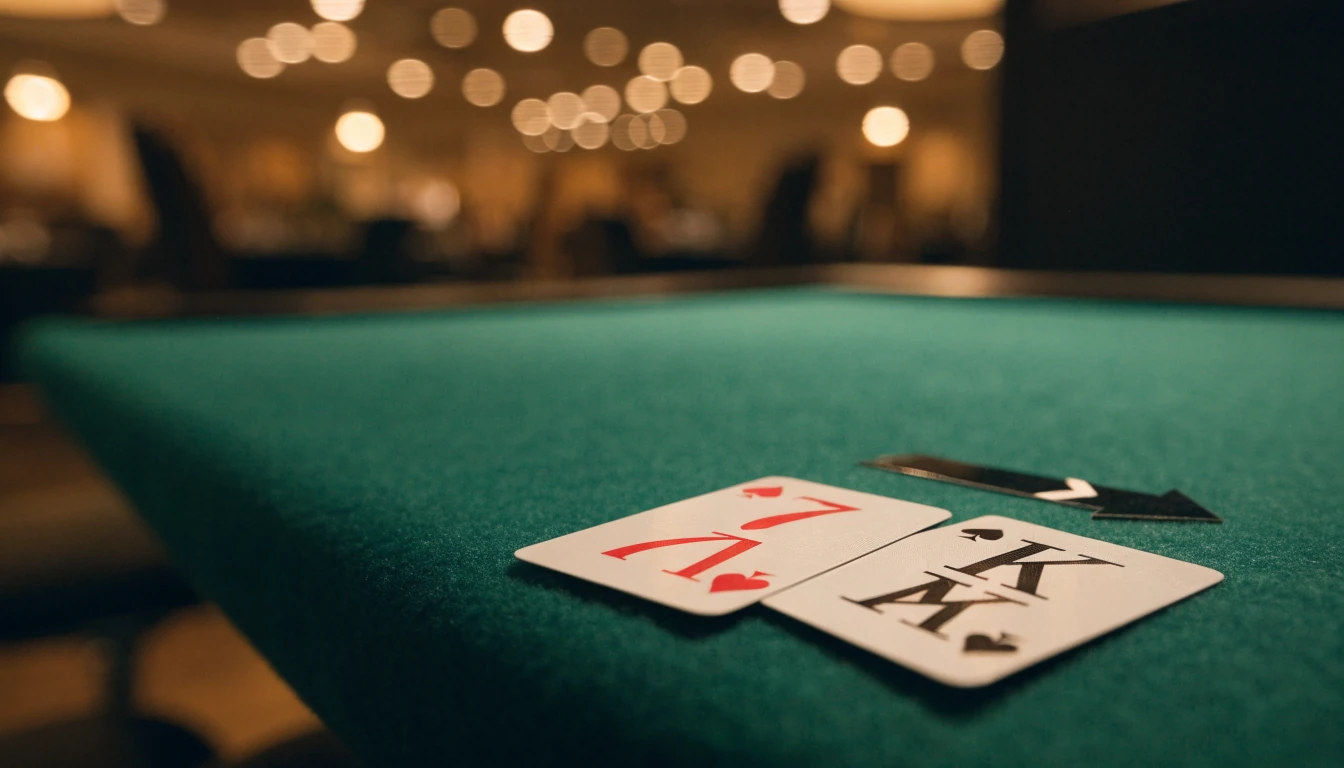
Hi-Lo decisions depend on the card already shown, with different formats shaping how guesses, payouts and cash-outs work.
Hi-Lo Rules: The Card That Sets the Next Decision
Hi-Lo starts with a simple comparison: a card is visible, and the next decision is whether the card that follows will be higher or lower. Some versions also let the player choose the same value. The rule sounds plain because the comparison is plain. What changes from one decision to the next is the card being used as the reference.
That reference matters more than the name of the game suggests. A guess is not simply “high” or “low” in the abstract; it is a prediction about the next card relative to the one already shown. If the reference card changes, the meaning of both choices changes with it. “Higher” has no fixed target, and “lower” is not a general description of the deck. Each is a direction from the current point.
I find that this is where Hi-Lo is easiest to misread. The choice appears binary, so it can feel as if the game is asking for an instinctive call. But the card on display defines the question. A low reference leaves plenty of values above it; a high reference leaves fewer. Around the middle, neither direction is self-evidently generous. That observation describes the shape of the choice, not a promise about the result of any particular draw.
The same distinction helps when reading a Hi-Lo casino game’s controls. The labels may be short, but they refer to separate outcomes: the next card can be above the reference, below it, or—where that option is offered—equal to it. A version without a same-value choice still asks for a comparison; it simply gives the player fewer labelled outcomes to select from. The available choices are part of the rules, not interchangeable wording.
There is also a difference between understanding the rule and knowing what a guess will produce. The current card frames the prediction, but it does not reveal the next card. A plausible-looking direction can still be wrong. I would keep those two ideas apart: the reference tells the player what “higher” and “lower” mean; it does not settle which one will occur.
Best RTP Casino Slots UK: Understanding RTP
This basic structure is shared by card-based Hi-Lo games, even though their other rules can differ. One game may present the decision in a different format from another, and the consequences of a correct, incorrect or equal result depend on that game’s rules. Those details should be read where they are stated rather than inferred from the name “Hi-Lo”. The common premise is narrower: compare the next card with the one currently setting the reference.
For anyone encountering Hi-Lo for the first time, that is the useful starting point. Ignore the impression that the labels themselves carry a prediction. Look at the reference card, then understand the choice as a direction relative to it. A small rule. The whole decision turns on it.
How to Play: A Round from the First Card to the Cash-Out
A Draw Hi-Lo round begins when the game deals a random card. That card is the reference point for the first decision. The player chooses whether the next card will be higher or lower, then confirms the wager. When the next card is revealed, the game settles that choice: a correct prediction pays according to the pay table, a tie pushes, and a wrong prediction loses.
After the first decision, the round is not an all-or-nothing commitment. If the guess wins, the player can continue with the accumulated winnings in play or leave the round and collect what has been built up. Each further choice follows the same pattern: assess the current card, select higher or lower when the direction is not obvious, and let the next card settle the wager.
The practical point is that continuing creates another decision, not a guaranteed extension of the earlier result. A correct guess can add to the amount available to collect, but a wrong guess voids all winnings collected in that game. The displayed total is therefore conditional until the round ends and the cash-out is taken.
Attention: A wrong guess voids all winnings collected during that game, making the displayed total conditional until the cash-out is taken.
There is no need to keep playing simply because the previous prediction was right. The stop option remains available after the first decision, so the round can end with a collection rather than another guess. I treat that choice as part of the game, not an afterthought: the player is deciding both which direction to call and when to stop putting the accumulated result at risk.
Hi-Lo Game Variants: Cards, Reels and Different Win Conditions
“Hi-Lo” describes a choice, not one fixed set of rules. A card-based game and a single-reel format can ask for the same higher-or-lower prediction while treating the crucial middle outcome differently. That changes the risk attached to each guess.
In the card game, the player predicts whether the next card is higher or lower than the reference card. A correct prediction is paid according to the pay table. If the cards have the same value, the bet pushes: the stake is returned rather than treated as a win or loss. A wrong guess loses the stake, and any winnings accumulated during that game are voided. The push matters because a tie is not simply a failed prediction.
A single-reel version has a more direct result. A player selects higher or lower, then the reel stops on a number. One specialist review describes a win when that number falls in the chosen direction, with a tie or a stop in the opposite direction counting as a loss. That is a materially harsher tie rule than the card game’s push. It should not be assumed to apply to every reel-based Hi-Lo game; the particular game’s rules determine the outcome.
Jackpot Mobile Casinos in the UK: How Prizes Work · Endorphina Casinos UK: Separating Claims from Facts
The same review describes a choice after a reel win: continue by putting the original bet and winnings at risk again, or collect and begin a new attempt. Continuing carries forward the result rather than making the previous win untouchable. Collecting ends that sequence. Small distinction, real consequence.
When comparing a hi-lo casino game, the useful question is therefore not just whether it uses cards or a reel. It is how the game defines a tie, what portion of the result remains at risk after a win, and whether a wrong guess wipes out earlier gains from that run. A card game that pushes on matching values gives the player a different settlement from a reel game that counts a tie as a loss, even if both present the same simple choice.
I treat the displayed rules as part of the game, not fine print. The label “easy” says little about the settlement. A single tie rule can change whether a guess preserves the stake or ends the attempt; a continuation option can turn a paid win into another exposure. Read the mechanics first. Then the choice makes sense.
Our top casino picks for the UK
- JetsetspinsBonus: 200% Bonus + 100 Free Spins + Free Royal Wheel · Payout speed: 1-3 business days
- BeOnBetBonus: 100% up to €500 + 100 FS · Payout speed: 1-3 business days
- ZombillionBonus: Welcome Pack 250% up to £4000 + 200 FS · Payout speed: 1-3 business days
- SlotoSportBonus: 500% up to £ 10 200+ 777 FS · Payout speed: 1-3 business days
- Revery PlayBonus: 100% up to€1,000+ 100 FS · Payout speed: 1-3 business days
- DieselwinBonus: Welcome Pack 250% up to £4000 + 200 FS · Payout speed: 1-3 business days
- BritsinoBonus: Welcome Package – Get your £2,200 + 2,000 FS · Payout speed: 1-3 business days
- NightLuckBonus: Welcome Pack + 805% Up To 6400€ + 280 FS · Payout speed: 1-3 business days
- ChanzeBonus: Slots Welcome Bonus #1 200% up to €500 · Payout speed: 1-3 business days
- x3betBonus: Welcome Pack 100% Up to £1.000 + 200 Free Spins · Payout speed: 1-3 business days
The Draw Hi-Lo Strategy Question: Basic Play or Card Counting?
Strategy figures for Draw Hi-Lo need to be read alongside its deck structure. The game uses one 52-card deck, with aces low, and dealt cards are not returned during play. That makes the remaining mix change as the game proceeds: a card already seen cannot turn up again in that game.
The game uses one 52-card deck with aces low, and dealt cards are not returned during play, meaning the remaining mix changes as the game proceeds.
A specialist review reports a 96.07% return for basic strategy. That figure describes the modelled result of following its recommended choices over repeated play; it is not a promise about an individual session. The pay table matters because a correct prediction pays according to its listed terms, while the relationship between possible outcomes and those payouts shapes the return. A sound-looking choice does not make the underlying edge disappear.
Card counting attempts to use the changing deck composition to refine decisions. A specialist review reports a 100.36% return for a counting strategy. That is a reported theoretical result, not a guaranteed profit, and it depends on the game conditions and pay table used in the analysis. A return above 100% can look decisive on paper. It is not a forecast of what happens next.
In practice, counting also requires accurate tracking of cards and applying that information consistently. The single-deck, no-replacement format makes past cards relevant, but it does not turn every decision into a certain one. The count informs the choice; it cannot restore cards to the deck or remove the uncertainty of the next draw.
The pay table is not decoration. It determines what a correct guess is worth, so a strategy calculation tied to one table should not be carried over to another without checking the terms. And a wrong guess voids all winnings collected in that game, making accumulated results vulnerable to a single mistake.
Fruit Machine Slots UK: How Online Games Work
I treat both return figures as comparisons between strategies under stated assumptions, not as a ranking of what a player will take away. The practical distinction is clear: basic strategy uses the game’s prescribed decisions, while counting adds a running estimate of which cards remain. Neither changes the fact that each game can end with a loss.
Live Hi-Lo: The Exposed Card, the Burned Cards and the Shuffler
Live Hi-Lo has a visible reference point that carries over from one hand to the next. The winning card from the previous hand remains exposed and serves as the comparison card for the next round. The new decision is therefore framed by a card already on display, rather than by a fresh starting card drawn for each hand.
That exposed card is part of the dealing sequence, not a new draw from the shoe. It has already appeared, so its role is to establish the reference for the next decision. The card that will determine the outcome has not yet been revealed. Before that next winning card appears, three cards are burned.
A burn is a card removed from the sequence of cards shown to settle the hand. It is not the card used as the reference, and it is not the winning card revealed after the burns. Keeping those stages distinct matters: the exposed card comes from the previous hand, the burned cards intervene, and the next winning card supplies the new result.
Live Hi-Lo Sequence
Exposed Reference
The winning card from the previous hand remains visible to set the comparison point.
The Burn
Three cards are burned and removed from the sequence before the result is revealed.
The Result
The next winning card is revealed to settle the hand and becomes the new exposed reference.
Once that result has been established, its winning card becomes the exposed reference for the following round. The same pattern repeats. In practical terms, the visible card moves forward from hand to hand, while the three burned cards belong to the interval before the next result. The previous result is carried forward; the intervening cards are not presented as that result.
The shoe works differently from a single deck that is dealt down until the cards run out. A continuous shuffler is used, and cards from the previous round are returned to it immediately. The process is therefore ongoing: cards are not kept aside as a used pile for later in the session. The exposed reference still matters for the next decision, but the cards that have already appeared are returned to the machine’s circulation.
That distinction can be easy to miss when a live table is described simply as a card game. The reference card is visible and has a specific job. The burned cards are part of the next reveal sequence. The shuffler handles the returned cards. These are separate pieces of the procedure, not interchangeable descriptions of the same card flow.
Descriptions of the deck arrangement do not agree across versions of Hi-Lo. One account of an online version specifies a single fifty-two-card deck with cards not returned after use. A specialist review, discussing a different arrangement, describes six forty-eight-card decks without tens and continuous shuffling; it also does not confirm that deck count in writing. Those accounts should not be collapsed into a single rule for every live or online game.
Video Slots in the UK: How They Work
This is why the exposed-card sequence should not be confused with the single-deck model. A single-deck game with no replacement treats cards already used as unavailable for the rest of that game. A live table with a continuous shuffler returns cards from the prior round straight back into circulation. The previous winning card remains exposed as the reference, but that does not mean every card from the preceding hand stays out of the shoe.
There is a useful operational distinction. The display tells the table which card defines the next comparison; the shuffler governs how cards move back into play. The three burns mark the interval before the next winning card is shown. Each has a separate function. No guess about the unseen sequence follows just from seeing the reference card or watching cards return to the machine.
That is the live format’s defining rhythm: reference card, burns, next result, then a new exposed reference. The procedure is visible, but it does not make the next card predictable. The table shows what the next decision is measured against—not what the shuffler will produce.
Live Hi-Lo Strategy: Why the Better-Paying Side Matters
In live Hi-Lo, the Higher and Lower buttons can carry different payouts. The practical guidance is to take the side offering the larger payout, rather than treating the two choices as interchangeable. That is a rule for comparing the displayed prices, not a promise that the higher-paying side is more likely to win. A generous return can compensate for a less favourable chance; the payout and the chance of the event have to be considered together.
Take the side offering the larger payout, as a generous return can compensate for a less favourable chance.
This distinction is easy to miss at the table. A player can focus on the exposed card and make a quick judgement about whether the next result is likely to be above or below it, while overlooking that the two sides may not pay equally. The price is part of the decision. If Lower pays more than Higher, choosing Higher solely because it seems more intuitive ignores a material part of the wager. Equally, the larger payout should not be mistaken for evidence that the side is a better bet in every sense.
The same card has particular significance when comparing Higher and Lower. If the next card matches the exposed reference card, neither direction has occurred. In this live game, a tie makes both Higher and Lower bets lose. That differs from a push: the stake is not simply returned because the result was neither above nor below. The possibility of a matching card therefore belongs in the assessment of both directional wagers, even when the exposed card makes one direction seem attractive.
That tie rule changes how the two displayed prices should be read. A payout is attached to a winning result, but the bet also has a losing result that includes a match. It is not enough to count only the cards that appear to favour Higher or Lower and disregard the tie. The decision is about the complete outcome of the wager. A displayed return cannot, on its own, describe the risk.
RTP Slots in the UK: How to Compare Games
A specialist review gives a return figure of 96.23% for betting Higher than 4 or Lower than 10. That figure is tied to those particular choices, not to every Higher or Lower bet in live Hi-Lo. It should be read as a calculated return for the stated approach, rather than a forecast of what a session will return or a guarantee about an individual result. The distinction matters: a percentage can summarise a model over repeated play, while a short run can still produce a very different outcome.
The two thresholds also show why a single slogan such as “always choose the higher payout” is incomplete. The payout must be read alongside the actual condition attached to that side. “Better-paying” describes the amount awarded if the wager wins; it does not mean that the bet has the best chance of winning, or that its expected result is automatically superior. In practice, the larger price is a useful comparison point, but it does not erase the tie or make the other side irrelevant.
Proposition bets and the missing card
Proposition bets need a separate adjustment. The exposed card from the previous hand is no longer in the shoe. A proposition should therefore be avoided if that exposed card itself would have counted as a winning result. Counting it as a possible future winner would treat an unavailable card as though it could still be drawn.
Proposition Bets
Avoid proposition bets if the exposed card would have been a winning result, as that card is unavailable and cannot be drawn.
This is not a minor bookkeeping detail. A proposition’s appeal depends on which outcomes remain possible. When one of the outcomes used to support the bet has already been removed, the apparent case for the wager is overstated. The correct question is not simply whether the exposed card matches the proposition, but whether that match is being counted as a future result. It cannot be. The card is visible, but it is not available.
There is a temptation to read the previous hand as a signal about what comes next. For this decision, the useful information is narrower: the exposed card can be excluded from the set of possible results. It does not justify treating the next draw as a prediction or as a correction for what happened before. The practical adjustment is to remove the unavailable outcome from the proposition calculation and avoid a wager that would win only by relying on it.
Classic Slots Online in the UK: How They Work
Higher and Lower decisions and proposition decisions therefore require different checks. For the directional bet, compare the side prices while remembering that a tie loses. For a proposition, check whether the exposed card is one of the outcomes that would pay, then do not count that card as still drawable. Those checks do not turn live Hi-Lo into a certainty. They prevent a visible price, or a visible card, from being mistaken for the whole calculation.
The arithmetic stays simple. The judgement does not.
Online Hi-Lo: How the Pot Changes with Each Guess
In an online Hi-Lo card game, the pot is not simply a running score. It represents money carried forward through a sequence of decisions, so each guess affects what remains at risk as well as what might be added. The card currently shown supplies the comparison point: the next card either ranks above it or below it.
Chicken Road Casino UK: Game Format and Risks
The card scale runs from ace, worth one point, through to king, worth 13. A guess is judged against those values, not against the suit or the card’s appearance. That distinction matters because a card can look different from the one before it and still have the same value. The basic higher-or-lower choice concerns rank.
When a prediction is right, winnings are added to the pot. A correct call therefore changes the amount carried into the next decision, but does not make that amount secure. It remains part of the game until the player stops or the run ends.
An incorrect guess loses the money placed on that decision. It also voids winnings collected during that game, rather than leaving the earlier pot intact as a consolation balance. That is the sharp edge of the format. A sequence of successful calls can make the pot look substantial, but a later mistake can erase the whole run’s accumulated winnings.
There is also a material disagreement about how the online deck is configured. One description gives a single 52-card deck, with cards removed after use and not returned during the game. Another describes six 48-card decks with continuous shuffling. These are not small variations in presentation: one setup makes previously revealed cards unavailable for the rest of the game, while the other continually reintroduces cards into the shuffled supply. The two accounts should not be blended into a claim that every online Hi-Lo casino uses the same deck.
Single-Deck Setup
Cards are removed after use and not returned during the game, changing the deck composition.
Multi-Deck Setup
Six 48-card decks are used with continuous shuffling, reintroducing cards into the supply.
That difference affects what can be inferred from the cards already seen. In a single-deck game without replacement, each revealed card changes the remaining composition. In a continuously shuffled multi-deck setup, the earlier sequence does not have the same lasting effect on what can appear next. The pot mechanic may look similar in both, but the information available for a decision is not equivalent.
From the counter side, “progressive” can sound reassuring; in practice, it means gains are exposed to later risk. The pot grows only when the game awards a correct prediction, and the amount displayed should not be mistaken for money already banked. The point at which play ends, and the consequences of a wrong call, matter as much as the visible total.
A fair comparison between online versions begins with the rules shown inside the game: card values, deck arrangement, what a correct guess adds, and what an incorrect guess removes. Without those details, two games with the same Hi-Lo label may offer different decision conditions. The label is not the mechanic.
Finding a Hi-Lo Site in Great Britain: Licence Checks and Account Controls
A Hi-Lo game can look identical across two casino sites while the protections around it differ sharply. In Great Britain, the first check is not the card interface, the welcome offer or the cashier. It is whether the business has the right UK Gambling Commission operating licence for the gambling it provides.
Plinko Casino UK: Regulation, Bonuses and Payments
The Commission regulates commercial gambling in Great Britain and is the sole regulator for that activity. Its reach does not depend on where a casino keeps its servers or other key equipment: remote operators serving consumers in Great Britain need the relevant licence. The Gambling Act 2005 provides the main legal framework in England, Wales and Scotland; Northern Ireland has a separate position.
Check the business, not just the badge
A logo or licence claim in a site footer is a starting point, not proof. The UK Gambling Commission’s public register allows a business’s status to be checked. The practical sequence is to identify the legal business named on the casino site, find that business in the register, and confirm that its operating licence is current and covers the activity being offered. Verify the licence number before depositing.
This matters because a gambling company and the people who operate it are not the same licensing subject. The Commission grants operating licences to businesses and personal licences to certain individuals working in the industry. A personal licence or a claim that a company is regulated somewhere else does not replace the operating licence required for gambling offered to Great Britain consumers.
A site based overseas is not automatically outside British rules. If it sells remote gambling into the British market, its location does not remove the licensing requirement. Conversely, a foreign regulator’s approval is not a substitute for a UK Gambling Commission licence. The distinction is regulatory, not cosmetic.
Licence and Safety Check
- Identify the legal business name on the casino site
- Verify the operating licence on the UK Gambling Commission public register
- Confirm the licence is current and covers the activity offered
- Check for age verification and financial limit controls
- Ensure no credit cards are used for funding
Account controls before play
Age verification is part of the account gate. A gambling operator must establish a customer’s age before allowing a deposit into a gambling account; online gambling at a UKGC-licensed casino is for adults aged 18 and over. A site that lets an account fund gambling before completing that check is not following the required sequence.
Financial controls should also be visible in the account, rather than buried in promotional copy. Remote operators must prompt new customers to set a financial limit before the first deposit and provide accessible account-level controls for limits. That gives the customer a way to set and adjust boundaries from the account itself. It is not a promise that a limit removes gambling risk; it is a required control that should be usable without searching through unrelated menus.
There is a separate payment rule that is easy to miss when a cashier presents several branded options. UK-licensed casinos cannot accept credit cards for gambling. The restriction also covers credit-card funding routed through a money service business, and operators cannot accept wallet payments where credit-card funds can be used for gambling. A payment label alone does not tell the whole story: the funding route matters.
Online Bingo UK: Formats, Tickets and Play
Complaints and stopping access
If a dispute arises, a UKGC licensee must have an internal complaints process and provide access to an approved Alternative Dispute Resolution service. The site should explain how to raise a complaint and how an unresolved case can reach the relevant ADR provider. Keeping the account’s terms, transaction history and complaint correspondence together makes the issue easier to describe clearly.
Self-exclusion is another required responsible-gambling tool. It should be available through the casino’s account controls, and GAMSTOP offers a separate self-exclusion service for online gambling. These are access controls, not a guarantee that gambling behaviour will change by itself. Support is available from services such as GamCare and the National Gambling Helpline; the NHS also provides health information and support.
The Commission’s oversight is backed by obligations on licensed operators, including a contribution to the Research, Education and Treatment levy. That funding duty is part of the regulatory framework, not a feature that makes one casino safer than another by itself.
For a Hi-Lo site, the useful order is therefore plain: establish the operating company, verify its licence on the Commission’s register, then inspect the age, limit, payment, complaint and exclusion controls. A polished game screen can be copied. The protections behind the account are the more consequential test.
What “Best” Means for an Online Hi-Lo Casino
Choosing a hi-lo casino involves more than the game itself, so it is useful to check practical details before deciding where to play. This list highlights the payout-speed information available for each operator.
1. BeOnBet
Payout speed: 1-3 business days
BeOnBet lists a payout speed of 1–3 business days, giving you a stated timeframe to consider when reviewing its hi-lo offering.
2. Jetsetspins
Payout speed: 1-3 business days
Jetsetspins lists payouts as taking 1–3 business days. That is the available practical detail to bear in mind when considering it for hi-lo.
3. Amunbet
Payout speed: 1-3 business days
Amunbet gives a payout-speed estimate of 1–3 business days, a useful detail for players weighing their options.
4. WinBeast
Payout speed: 1-3 business days
WinBeast states a payout speed of 1–3 business days. This provides a clear timeframe to factor into your hi-lo casino choice.
5. Dieselwin
Payout speed: 1-3 business days
Dieselwin lists a payout speed of 1–3 business days, offering a stated timeframe to consider alongside its hi-lo games.
6. Chanze
Payout speed: 1-3 business days
Chanze reports payouts in 1–3 business days. This is the available detail to help inform your choice.
7. Revery Play
Payout speed: 1-3 business days
Revery Play lists a payout speed of 1–3 business days, giving players a stated timeframe to take into account.
8. Britsino
Payout speed: 1-3 business days
Britsino gives a payout-speed estimate of 1–3 business days. This practical detail may help when considering where to play hi-lo.
9. SlotoSport
Payout speed: 1-3 business days
SlotoSport lists payouts as taking 1–3 business days, providing a timeframe to consider as part of your decision.
10. x3bet
Payout speed: 1-3 business days
x3bet states a payout speed of 1–3 business days. This is a useful point to note when assessing its hi-lo offering.
“Best” is a label, not a game mechanic. In Hi-Lo, the useful comparison is between the rules actually offered, the return those rules support and how plainly the game explains its decisions. A polished screen or a prominent position in a casino lobby cannot answer those questions on its own. I have found it more useful to treat the game as the product and the surrounding presentation as evidence to check.
A specialist review reports a 96.07% return for Draw Hi-Lo when played with basic strategy. That figure is a point of reference for that described game and approach, not a promise about every online Hi-Lo title. It should not be transferred to a different version merely because the name is similar. A reel-based game, a live card game and a single-deck online game can use different rules and payout structures; their returns are not interchangeable.
The figure also describes a calculated return over play, not what a particular session will produce. A player can experience a very different result. In the described Draw Hi-Lo format, an incorrect guess loses, while a correct one pays according to the pay table and a tie pushes. The ability to stop and collect accumulated winnings does not make the underlying return higher. Nor does it remove the risk that a wrong guess will void all winnings collected in that game.
Do
- Check the pay table and rules for the specific game version
- Use return figures as a reference point for a described strategy
- Match the return percentage to the exact game mechanics
Don’t
- Transfer return figures between different Hi-Lo versions
- Mistake a calculated return for a guaranteed individual result
- Assume a polished interface improves the financial return
That distinction matters when a game is promoted as “high return”. The phrase can sound like a practical advantage in every round, when the number is instead an aggregate measure under stated assumptions. I would look for the rules and pay table alongside any return figure, and check that the figure is clearly attached to the exact game version being offered. If the presentation gives a percentage but leaves the underlying mechanics unclear, the percentage is doing more work than it should.
The pay table deserves particular attention because it connects a correct decision to its payout. A higher-or-lower choice is not, by itself, enough to establish the value of a game. The possible outcomes, including ties, and the amounts awarded for successful decisions shape the calculation. A useful comparison therefore asks whether the displayed pay table is complete and whether the game’s explanations match it. Small differences in rules can change what a headline return means.
I also separate the quality of the game from the quality of its interface. Clear card values, legible prompts and an understandable record of the current decision can make the mechanics easier to follow. They do not improve the return. Conversely, an elaborate interface does not prove that a game is poor; it simply offers no substitute for checking how the game works. “Easy to play” describes the presentation, not the financial outcome.
High-Volatility Slots in the UK: What to Expect
Consistency is another practical test. The name, rules, pay table and return information should describe the same version throughout the game and its accompanying information. A discrepancy is not a minor copy-editing issue: it makes comparison unreliable. If a game offers more than one mode, each mode needs to be assessed on its own terms rather than treated as one product with one universal figure.
I would also resist treating a casino’s range of games as evidence that its Hi-Lo offering is the strongest choice. A broad lobby says little about a particular game’s rules or return. The relevant evidence is specific: the version available, its stated mechanics, its pay table and any return calculation tied to those details. Without that, “best” is an advertising judgement rather than a conclusion that can be checked.
A careful comparison need not produce a single winner. It can establish which game is better documented and which claims are supported by details that can be inspected. For Draw Hi-Lo, the reported 96.07% basic-strategy return provides a concrete benchmark, but only for that described game. The practical question is whether the game being considered matches the description and whether its information makes that clear.
That is a narrower standard than a ranking, and a more useful one. It avoids treating a return figure as a guarantee, a familiar title as proof of identical rules, or a smooth interface as a measure of value. In Hi-Lo, the strongest claim is the one that can be traced back to the exact game mechanics. No gloss required.
SpinDog Games
BGaming Online Casinos UK: What to Verify
Learn how to verify a slot’s provider, distinguish BGaming from casino claims, and assess what the available evidence does—and does not—confirm.
Barcrest Slots in UK Casinos: What to Check
Learn why supplier labels do not prove game availability, and how to assess free-play terms, licensing, mobile access and bonus conditions.
Live roulette in the UK with English-speaking dealers
Learn how live tables differ from RNG roulette, how the stream and betting interface work, and what to check in roulette rules, limits and bonus terms.
Progressive Jackpot Slots in the UK: How They Work
Learn how connected machines fund shared prize pools, why games may differ by casino, and where eligibility is set by game rules and terms.
Created by the "SpinDog UK Guide" editorial team.