
European Roulette at UK Online Casinos: Rules & Odds
 Available in GB
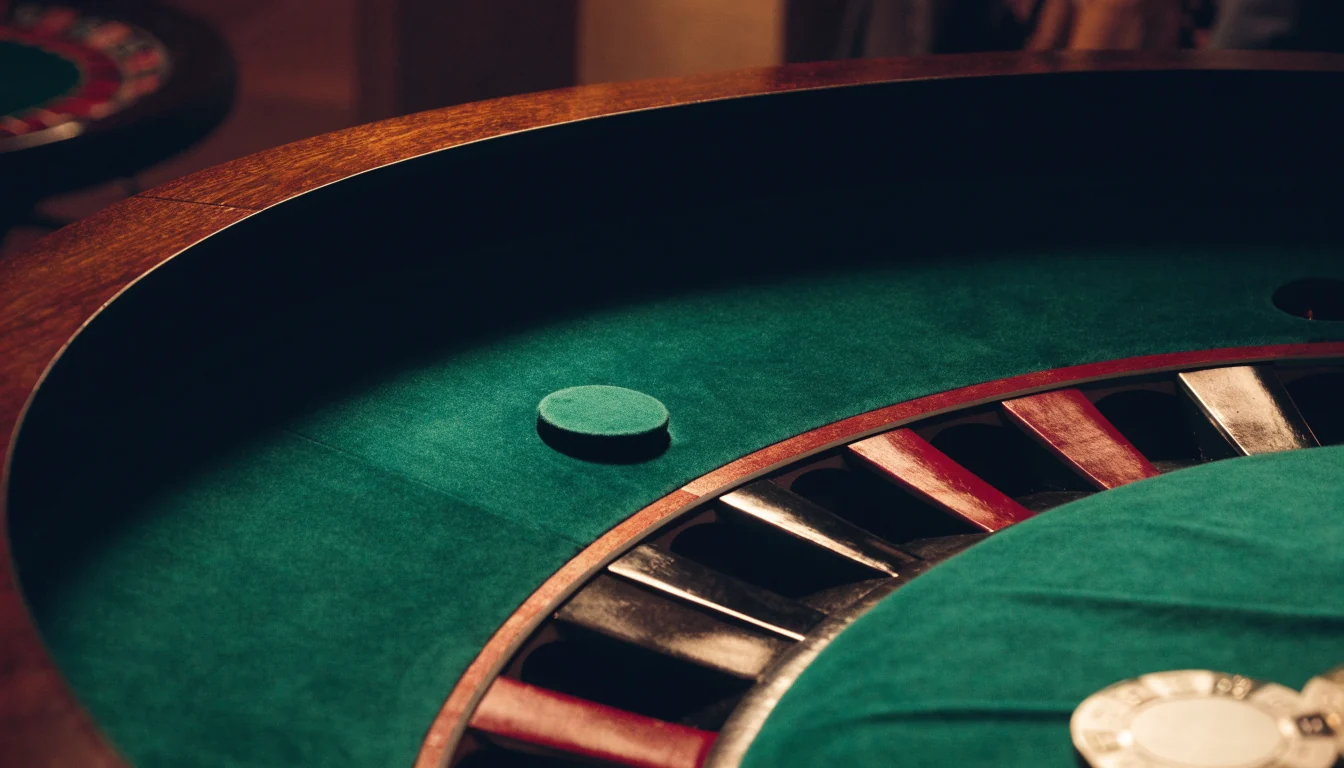
A practical guide to single-zero tables, bet types, formats and the difference between European and American roulette.
European Roulette’s Single-Zero Edge
European roulette is built around a wheel with one green zero alongside the numbered pockets. That single-zero design is the defining feature behind its familiar mathematical edge: the house edge is 2.70%. The figure is not a prediction of what will happen on the next spin. It describes the game’s built-in advantage across repeated play, given the standard rules and payouts.
I have found that the phrase “low edge” can be made to sound more reassuring than it is. The percentage is small enough to be easy to overlook, but it still means the game is not evenly balanced between the player and the casino over time. A particular session can finish either way. The edge does not say that a casino will win every session, or that a player cannot leave ahead. It describes the underlying arithmetic, not the timing or direction of individual results.
The reason the zero matters is straightforward. A European wheel has 37 pockets, while the usual payout structure treats winning outcomes as though the wheel were divided into 36 equal parts. That gap is where the casino’s advantage comes from. Without the zero, the standard returns would balance the chances on an even basis; with it, the payouts do not fully compensate for the extra losing outcome. The house edge expresses that difference as a proportion of the amount wagered over the long run.
Online Bingo UK: Formats, Tickets and Play
That distinction is useful when comparing an online casino offering European roulette with the game as it appears elsewhere. The setting may be digital, but the number at the centre of the calculation is still the wheel’s single zero and the stated rules. A polished interface, an animated wheel or a busy lobby does not alter the edge by itself. The relevant question is whether the game follows the standard European structure and payout schedule. Presentation can change; mathematics only changes when the rules do.
The 2.70% figure is an average over repeated wagers, not a charge taken from each stake before a spin. A player does not see a fixed deduction every time the ball lands. Individual outcomes remain uncertain, and short stretches can depart sharply from the long-run expectation. The percentage becomes meaningful when many wagers are considered together. More play gives the underlying rate more opportunities to show through, though it never turns a random result into a scheduled one.
Online Slots Payout Percentage: What It Means
This is where casino language can blur two different ideas. A game may be described as “fair” because the result is random and the published rules are applied consistently. That does not mean the player and casino have equal mathematical prospects. Randomness concerns how a result is selected; the house edge concerns how the payouts compare with the chances of the possible results. Both can be true at once: each spin is uncertain, while the game’s overall structure favours the house.
For online European roulette, the same point applies whether the game is played on a screen with a generated result or presented in another format. The format may affect pace and atmosphere, but it does not, on its own, make the single-zero edge disappear. The game’s rules remain the basis for understanding its mathematics. Small differences in presentation can be conspicuous; the more important detail is often less visible.
Live Dream Catcher Casino UK: Format and Checks
When I look at the numbers behind a European roulette casino, I start with the edge rather than the surrounding claims. A 2.70% house edge is a clear reference point for the standard game. It does not establish that every table carrying the European label has identical terms, so the rules attached to a particular table still matter. But it does make the central trade-off plain: the wheel gives the casino a statistical advantage, even though no one can know how that advantage will appear in a particular run of spins.
That is the practical meaning of the single-zero edge. It is not a promise about a player’s result and not a measure of how exciting a table feels. It is a compact description of the difference between the game’s chances and its payouts. Once that is understood, the appeal of European roulette can be considered without mistaking a favourable-looking result for a change in the underlying odds.
The figure is fixed by the standard structure, not by a lucky streak. The outcome is not.
What “Best” Means When Comparing Roulette Casinos
Choosing an online casino for European roulette involves more than the game itself; payout timing can also be useful to consider. The details below provide a brief reference point for readers exploring options in the UK in 2026.
1. BeOnBet
Payout speed: 1-3 business days
BeOnBet lists a payout speed of 1–3 business days, a useful detail to consider when reviewing it for European roulette.
2. Jetsetspins
Payout speed: 1-3 business days
Jetsetspins lists a payout speed of 1–3 business days. This gives readers one concrete detail to weigh when considering the operator.
3. Amunbet
Payout speed: 1-3 business days
Amunbet lists a payout speed of 1–3 business days, offering a specific point of reference for readers considering it.
4. WinBeast
Payout speed: 1-3 business days
WinBeast lists a payout speed of 1–3 business days. Readers can use this as one practical detail when assessing the operator.
5. Dieselwin
Payout speed: 1-3 business days
Dieselwin lists a payout speed of 1–3 business days, providing a concrete detail for readers to consider.
6. Chanze
Payout speed: 1-3 business days
Chanze lists a payout speed of 1–3 business days. This is a helpful reference point when reviewing the operator.
7. Revery Play
Payout speed: 1-3 business days
Revery Play lists a payout speed of 1–3 business days, giving readers a specific detail to consider alongside their roulette preferences.
8. Britsino
Payout speed: 1-3 business days
Britsino lists a payout speed of 1–3 business days. This provides one practical point of reference for readers considering it.
9. SlotoSport
Payout speed: 1-3 business days
SlotoSport lists a payout speed of 1–3 business days, a useful detail to keep in mind when reviewing the operator.
10. x3bet
Payout speed: 1-3 business days
x3bet lists a payout speed of 1–3 business days. Readers can consider this stated timing as part of their assessment.
“Best” is not a property of a casino in isolation. It is a judgement about the terms attached to the particular roulette game and offer: what the published return figure represents, whether bonus funds can be used on roulette, how much those wagers count towards wagering requirements, and whether the operator is entitled to serve the British market. I have seen attractive headline offers become much less useful once those conditions were read together.
Start with the published RTP
RTP, or return to player, is the long-run theoretical return stated for a game. It is not a forecast of what an individual session will return, and it does not promise a particular result. A casino comparison is incomplete if it names roulette games but makes their RTP information difficult to find. UKGC-licensed operators should make that information accessible; check the game details and help pages rather than assuming that a general casino figure applies to every roulette title.
Attention: An advertised RTP is a theoretical measure over extended play and not a guarantee that a player will come out ahead in a particular session.
The wording matters. A figure attached to a specific game may not describe every version offered under a similar name. Nor should an advertised RTP be treated as a measure of service quality or proof that a player will come out ahead. It is one published characteristic to compare, not a verdict.
That distinction is easy to lose in marketing. “Higher return” sounds like an outcome. In practice, RTP is a theoretical measure over extended play, while the result of a particular session remains uncertain. Keep the claim in its proper lane.
Read bonus terms as a separate calculation
A bonus can look generous while roulette contributes little towards the requirements attached to it. Most UK operators count roulette wagers at a rate between 10% and 20% of bonus wagering requirements. That means a roulette stake may advance the requirement by only a fraction of the amount wagered. The headline bonus and the game-weighting rule are separate pieces of the offer.
The rate can also depend on format. A specialist review reports that some operators give live roulette a 10% or 20% game weighting while assigning RNG roulette a 100% rate. Treat that as a reported example of variation, not a rule that applies across the market. The operator’s own terms are the controlling document: check the named game category, excluded games, eligible balance and any conditions that apply before relying on the advertised offer.
A separate specialist review states that a UK bonus-wagering cap took effect in January 2026, setting the maximum requirement at ten times the bonus amount for licensed operators. That report should not replace reading the offer’s actual terms. A ceiling does not tell the whole story: game weighting still affects how quickly roulette play counts, and other conditions may determine when bonus funds can be withdrawn.
The practical comparison is therefore not simply “bonus versus no bonus”. It is the stated amount, the wagering requirement, the roulette game-weighting rate and the rules governing eligibility. If those are not easy to establish, the offer is hard to assess.
Treat the licence as a basic condition
For real-money roulette in Great Britain, licence status is not an optional extra in a comparison. The UK Gambling Commission regulates online casino activity, and operators serving the British market must hold the relevant UKGC licence. A platform without a valid UKGC licence cannot legally offer real-money roulette to British residents.
Licence Status
A platform without a valid UKGC licence cannot legally offer real-money roulette to British residents.
I would check the operator’s licence entry on the UKGC public register before depositing, and make sure the business name matches the casino presented on screen. A logo or a claim in promotional copy is not the same as confirming the licence record. This check does not establish that every offer is worthwhile; it establishes whether the operator is authorised to serve the market.
UKGC-licensed live casino operators must also provide account safeguards, including deposit and loss limits, session reminders, reality checks, cool-off periods and GamStop self-exclusion. These are part of the regulated environment, not a substitute for comparing RTP or bonus conditions.
A sound comparison keeps the categories distinct: published game information, offer mechanics and regulatory status. The word “best” does not settle any of them. The terms do.
How Roulette Bets Work—and Why No System Beats the Odds
Roulette betting is easier to follow when the possible outcomes are grouped by the kind of prediction being made. Outside bets cover broad categories rather than one precise number: red or black, even or odd, and low or high. Each pays 1:1, so a winning bet returns an amount equal to the stake, alongside the stake itself.
That payout can look reassuring because the categories cover many pockets. But a broad bet is not a promise of a regular win. Each spin is a separate event, and the result is determined by chance. A run of red does not make black more likely on the next spin; the wheel has no memory.
In my experience, the confusion often begins when a simple bet is treated as a reliable way to earn. “Steady returns” is a sales phrase, not a property of the bet. A 1:1 payout describes what happens if the wager wins. It does not say how often that will happen, or when.
Online Casino Tournaments in the UK: How They Work
A practical way to understand how to play European roulette is to decide what the bet is meant to cover, then read its displayed payout before confirming it. Outside bets make the choice straightforward, but they do not change the basic uncertainty of a spin. The same principle applies when playing online: a clear interface can make a wager easier to place, not easier to predict.
Why doubling does not solve a losing run
The Martingale system is the familiar attempt to recover losses by doubling the next stake after each loss. The reasoning sounds tidy: a later win might recoup earlier losing bets and leave a small gain. The weakness is that it assumes the next result will cooperate.
It may not. A losing streak can continue, and each doubled stake makes the amount exposed grow quickly. A player’s bankroll can be damaged before a win arrives. The system does not alter the roulette outcome or give the next bet special information. It only changes how much is at risk.
That distinction matters. A betting pattern can organise decisions, but it cannot turn chance into a forecast. No roulette strategy can predict the final outcome. Red, black, even, odd, high and low remain uncertain on every spin, whether the stakes are small or large.
The same limit applies to play for fun or practice. A free game can help someone understand the choices and the way payouts are displayed, but it cannot demonstrate that a system will predict future results. A run of wins in one session is still a run of results, not proof of an edge.
Do
- Use outside bets for simple choices
- Rely on the clearly stated 1:1 payout
Don’t
- Assume a betting system improves the forecast
- Use doubling to turn chance into a predictable outcome
The useful takeaway is modest: outside bets offer simple choices and a clearly stated 1:1 payout, while staking systems merely rearrange exposure. They do not improve the forecast. No shortcut.
Finding European Roulette Across Online Casino Formats
European roulette can appear in an online casino catalogue in several forms, so the game name alone does not tell the whole story. A listing may open a computer-generated game, an automated table or a live-dealer stream. The underlying roulette variant may be European in each case, while the pace, presentation and way a spin is produced differ.
I learned to check the format label before treating two listings as equivalent. “European” identifies the roulette variant; it does not necessarily mean a physical wheel is being used. In an RNG game, software uses a random number generator to produce each result. This makes play faster than waiting for a live table, and minimum stakes can be lower—sometimes as little as 10p. For someone looking for brief sessions or smaller individual bets, that can be a practical distinction.
A live listing, by contrast, connects the game to a physical wheel streamed from a studio. The result comes from a real ball drop rather than a simulated spin. The dealer and wheel are part of the broadcast, so the experience is closer to watching a table in progress. The dedicated live-table format has its own pace and presentation; here, the useful point is simply that “European roulette” can describe both a software game and a streamed physical game.
Play’n GO slots at UK online casinos: what to verify
Catalogue organisation is not always consistent. Some casinos group roulette under table games, while others use filters for provider, format or game type. Search or category results can also place branded games beside standard roulette. That does not make them interchangeable: the title and game information should be read together, rather than assuming every result offers the same rules or presentation. Advertising language can blur the distinction. “Live” should mean a live stream, not merely a realistic-looking interface.
When I checked catalogues, the clearest signal was the game’s information panel. It can identify whether the game is RNG-based or live, name the provider and set out the available rules. A thumbnail is less useful: a green-felt table image does not establish that a physical wheel is involved. Where the format is unclear, the listing itself has not answered the practical question.
The choice is less about one format being universally better and more about what the session is meant to feel like. RNG play removes the wait between simulated spins; a physical-wheel stream makes the dealer and ball part of the viewing experience. Neither label changes the need to understand the particular game’s stated rules. Different format. Same need to check.
Our top casino picks for the UK
- JetsetspinsBonus: 200% Bonus + 100 Free Spins + Free Royal Wheel · Payout speed: 1-3 business days
- BeOnBetBonus: 100% up to €500 + 100 FS · Payout speed: 1-3 business days
- ZombillionBonus: Welcome Pack 250% up to £4000 + 200 FS · Payout speed: 1-3 business days
- SlotoSportBonus: 500% up to £ 10 200+ 777 FS · Payout speed: 1-3 business days
- Revery PlayBonus: 100% up to€1,000+ 100 FS · Payout speed: 1-3 business days
- DieselwinBonus: Welcome Pack 250% up to £4000 + 200 FS · Payout speed: 1-3 business days
- BritsinoBonus: Welcome Package – Get your £2,200 + 2,000 FS · Payout speed: 1-3 business days
- NightLuckBonus: Welcome Pack + 805% Up To 6400€ + 280 FS · Payout speed: 1-3 business days
- ChanzeBonus: Slots Welcome Bonus #1 200% up to €500 · Payout speed: 1-3 business days
- x3betBonus: Welcome Pack 100% Up to £1.000 + 200 Free Spins · Payout speed: 1-3 business days
Single-Zero Tables: What the Layout Tells You
On a European roulette wheel, the green zero sits among the numbered pockets rather than in a separate double-zero compartment. There are 37 pockets altogether: the numbers from 1 to 36 and one zero. The betting layout reflects that structure. The numbered area is arranged in three columns, while zero has its own position at the end of the grid.
On a European wheel, the green zero is part of the outcome space, which prevents most simple bets from being even chances.
That separation is more than a visual convenience. A bet on a number, a group of numbers or a colour is placed on the felt, but the ball can still land on zero. The green pocket is therefore part of the outcome space even though it does not belong to the red or black numbers, or to the even or odd numbers. A table can look balanced, but the zero is the detail that prevents most simple bets from being even chances.
Reading the positions
The grid gives each number a specific place. A chip placed on an individual number marks a single-number selection; chips placed on the lines or corners between numbers mark combinations. Those are inside bets because they sit within the numbered section of the layout. Their position shows which outcomes are covered, not which outcomes are more likely.
Outside bets occupy the areas around the grid. These include choices such as red or black, odd or even, and low or high numbers. Their broader coverage is immediately visible: the chip is not tied to one square. But zero remains outside those categories, so a result on green does not become red, black, odd, even, high or low.
I have seen players read the green space as a minor exception because it takes up little room on the felt. It is not minor in the calculation. The ordinary European game has a 2.70% house edge, and that advantage is built into the single-zero layout. A neat grid does not remove it. It only makes the available selections easier to see.
French Roulette Online Casinos in the UK: Rules
The La Partage distinction
Some European tables apply La Partage to eligible even-money bets. If the ball lands on zero, half of the stake on those bets is returned rather than the whole stake being lost. On those qualifying wagers, the house edge falls to 1.35%.
The distinction is specific: La Partage concerns even-money bets, not every chip position on the table. A single-number bet does not become a half-refund bet simply because it was placed on a single-zero layout. The table rules determine whether La Partage applies, so the felt alone may not tell the whole story.
That matters when two tables look almost identical. The wheel can have the same single zero and the betting grid can offer the same positions, yet a rule attached to zero changes the treatment of certain wagers. I check that rule separately from the layout. Small print, real consequence.
Free Play and Real-Money Roulette Are Different Decisions
A free European roulette demo and a real-money game may look almost identical on screen. The difference is what each spin puts at risk. In demo mode, the balance is simulated: it allows the game’s pace and interface to be tried without staking cash. A result can be useful for learning where controls sit, but it says nothing about what a real-money session will return.
RNG roulette uses a random number generator to produce each simulated spin. That makes play quicker than waiting for a physical wheel, and minimum stakes can be lower. Some games allow stakes as low as 10p. The amount shown on a particular table still depends on its own settings; a demo balance does not establish what the real-money minimum will be.
Stake limits by format
Specialist reviews report UK live roulette minimums starting at 10p, while auto-roulette and speed formats sometimes start as low as 5p.
Entry points vary by format. A specialist review reports UK live roulette minimums starting at 10p, with auto-roulette and speed formats sometimes starting at 5p. Those are reported examples, not a promise that every table will offer the same stake. The small figure can make a game appear low-risk, but repeated spins still add up. Faster play can make that happen sooner.
I have seen the word “free” do a lot of work in casino menus. In a demo, it means no cash stake is being placed; it does not mean that the experience predicts a real-money outcome. A roulette demo is also distinct from a slot demo, even if a catalogue groups both under casino games. The interface may be familiar, but a simulated balance and withdrawable winnings are not the same thing.
Real-money European roulette in Great Britain sits within a different framework. The UK Gambling Commission regulates online casino activity, and operators offering gambling to British customers must hold the relevant UKGC licence. Before allowing a customer to deposit, an operator must verify their age. New customers must be prompted to set a financial limit before their first deposit, with account-level limit controls available thereafter.
The safeguards continue beyond the first deposit. UKGC-licensed live casino operators must offer deposit and loss limits, session time reminders, reality checks, cool-off periods and GamStop self-exclusion. These controls are part of the operating environment, not an optional feature attached to a particular roulette table. A licence does not make a session profitable; it sets conditions for how the service may be provided.
Best Online Casinos with No Limits: UK Guide
That distinction is the practical one. Free play can familiarise someone with the software without risking funds. Real-money play involves a verified account, a permitted operator and controls that can shape how long or how much someone gambles. Same wheel on screen. Different decision.
Reading the Roulette Table: Numbers, Neighbours and Payouts
On a European roulette table, the betting grid is a map of the numbered pockets, not a picture of where those pockets sit around the wheel. The numbers are laid out in horizontal rows of three. A bet can cover one number, a pair of neighbouring numbers or a whole row; its position on the felt tells the game which outcome or outcomes are covered.
A straight-up bet sits inside one numbered box. If the ball lands on that number, the payout is 35:1. The same quoted payout applies to a straight-up bet on American roulette, so the figure alone does not identify which wheel is being used. The table label matters.
For a split bet, the chip is placed on the line between two adjacent numbers. That may be a shared horizontal border or a shared vertical border, depending on the pair. The bet wins if either number comes up and pays 17:1. On a digital table, the equivalent is selecting the dividing line or using a bet control that clearly identifies the pair. A chip that lands inside a box is not a split.
A street bet covers a horizontal row of three numbers. Its marker belongs on the outer edge of that row, rather than inside one of its boxes or on a line between two boxes. The payout is 11:1. This is where a quick visual check helps: the covered numbers should run across one row, not down a column.
Straight-Up Bet
Example: 35:1 × stake = winnings plus the original stake returned.
I have seen table errors come from treating every nearby number as a neighbour in the same sense. On the grid, adjacency means touching positions; on the wheel, the order is different. A split follows the grid’s shared border, not the next pocket around the physical wheel. That distinction is easy to miss when a screen shows both the betting layout and a wheel graphic.
The printed or digital layout also separates inside bets on numbered boxes from the broader marked areas around them. A bet placed on a boundary can cover more than one outcome, but only if the marker sits on the correct boundary. Before confirming, the bet slip or highlighted positions should match the intended coverage.
Payouts are quoted as winnings relative to the stake, with the original stake returned on a winning bet. The larger payout for a single-number selection does not make the number more likely to appear; it reflects the narrower coverage. Reading the grid accurately clarifies what has been selected. It does not change the odds.
Roulette-Branded Slots and Lightning-Style Games
A roulette-themed slot is not the same product as a European roulette table, even when its title includes “roulette” or its graphics borrow the wheel, numbers or casino colours. A three-dimensional roulette slot, or a game labelled “Gold” or “Platinum”, may be presented among roulette results because of its branding. Those labels alone do not establish that the game uses a physical roulette wheel, the European table layout or the odds of a standard roulette spin.
Online Casino Without ID in the UK: What to Expect
The distinction matters because the underlying mechanics differ. In standard European roulette, a wager is settled against the result of a wheel spin. A slot-style game instead follows its own game rules and pays according to its own symbols and features. A roulette reference in a title is not evidence that its return, volatility or betting options match roulette. The game information panel is the place to identify the product type and its published rules.
Lightning Roulette is closer to the table game, but its special feature can change the return on a winning straight-up bet. A specialist review reports that a straight-up win without a lightning multiplier pays 29:1, rather than the 35:1 associated with a standard roulette straight-up bet. That difference is easy to miss when attention is drawn to the chance of a boosted payout. The boosted possibility is only one part of the terms; the ordinary payout matters too.
The same specialist review reports that outside bets in Lightning Roulette retain standard roulette payouts. That means the lightning feature does not, on that account, alter the stated payout for red or black, even or odd, or high or low. It does not make those bets more likely to win. The wheel result remains uncertain, and the feature should not be read as a general improvement to the game’s odds.
This is where “enhanced” becomes a marketing word. It describes the extra feature, not a blanket advantage for every wager. A comparison between a conventional European table and a branded variation needs to separate the chance of a special multiplier from the ordinary payout schedule and from the game’s underlying rules. Small print matters. So does the category.
For anyone comparing games, the practical check is simple: confirm whether the title is a slot or a roulette table, then inspect the rules for the exact bet and payout in question. A familiar wheel graphic can make two different products look like one. They are not.
Attention: A roulette-themed slot is not a table game; it follows its own rules and payouts regardless of the wheel graphics used.
What a Live European Roulette Table Adds
A live European roulette table replaces a software-generated spin with a streamed physical wheel. A human dealer sets the ball in motion, and the result comes from its drop onto the wheel. The game is still played online, but its central event is visible as it happens rather than represented by an animation.
That changes the feel of a session. There is a dealer’s pace to follow: the ball is released, the wheel turns, the result is called, and the next round begins. I find that this can make the game feel more like watching a table than running a sequence of quick simulations. It does not change what roulette is, or make a result easier to anticipate. The wheel still decides.
The trade-off is time. A standard live table allows room for the physical sequence to play out, while automated games can move more quickly. A specialist review reports speed roulette at more than 150 spins an hour, against 80–100 at a standard table; those figures describe the formats covered by that review, not a fixed rate for every table. More rounds in less time can mean a bankroll is exposed to decisions faster. That is the practical difference. Not an advantage.
A live European roulette casino table is therefore suited to players who value the streamed wheel and human dealing over pace. The screen shows a real ball drop, but the stream does not turn the game into a private or predictable one. It remains a chance-based table game, and the live presentation is about how the spin is delivered.
In Great Britain, real-money live roulette must be offered by a UKGC-licensed operator; a platform without a valid UKGC licence cannot legally offer it to British residents. UKGC-licensed live casino operators must also provide deposit and loss limits, session-time reminders, reality checks, cool-off periods and GamStop self-exclusion. Those controls sit alongside the game, rather than changing the wheel.
Microgaming Slots in the UK: Checking Casino Claims
That is what live dealer roulette adds: a physical event on screen, a human dealer and a slower rhythm than automated play. The format brings atmosphere and visibility, not different odds or insight into the next result.
European Roulette Versus American Roulette
The key difference is not the colour of the felt or the pace of a spin; it is the number of pockets sharing the outcome. European roulette has numbers 1 to 36 and one zero, giving the wheel 37 pockets. American roulette adds a double zero, so the wheel has 38. That extra pocket changes the maths on standard bets: the stated house edge rises from 2.70% on European roulette to 5.26% on American roulette.
That distinction can be easy to miss in an online casino game catalogue. A title may simply say “roulette”, while the game itself uses either wheel. I make a point of checking the rules panel before treating two tables as equivalent. The familiar layout does not make their odds interchangeable.
Jackpot King Slots at UK Online Casinos: Facts
The American basket bet brings a further disadvantage. It covers 0, 00, 1, 2 and 3, but its house edge is 7.89%—higher than the American game’s general edge. The appeal is a single wager covering several pockets; the cost is a less favourable return. A broader-looking bet is not necessarily a better one.
There is also a less common variation to recognise. A specialist review describes some American tables with a third green pocket marked 000; on that version, the house edge is 7.69%. This is a specific table feature, not a reason to assume every American wheel has three zeros. The rules shown for the individual game settle the point.
When comparing an online European roulette casino game with an American table, the practical distinction is therefore straightforward: count the green pockets, then consider the stated edge and available bets. The European wheel’s single zero leaves it with the lower house edge of these two standard versions. The American double zero increases the house advantage, and the basket bet increases it further.
Different wheels. Different terms.
Should I play American or European roulette if I’m in the UK?
European roulette has the lower house edge: 2.70%, compared with 5.26% for American roulette. The American basket bet has an even higher edge of 7.89%.
What are inside and outside roulette wagers?
Inside bets cover specific numbers or small groups of numbers, such as straight-up, split and street bets. Outside bets cover broader categories, including red or black, even or odd, and high or low.
How does the 10x wagering cap affect roulette bonuses?
Since January 2026, bonus wagering requirements at UK-licensed operators are capped at 10 times the bonus. Roulette wagers may contribute only 10% to 20% towards those requirements, though RNG roulette can count at 100%; check the operator’s bonus terms for the game’s contribution rate.
SpinDog Games
Monopoly Live Casino UK: Live Play and Rules
Learn how the live-dealer format differs from a game title, why UK Gambling Commission licensing matters, and what to check in roulette and blackjack rules.
Quickspin Online Casinos UK: What Can Be Verified
Learn how provider filters differ from game-level attribution, and why casino availability, offers, RTP and mobile claims need title-specific evidence.
Habanero Online Casinos UK: What Can Be Verified
Learn how to assess Habanero game labels, mechanics and availability. The UK Gambling Commission oversees gambling activity, including casino gambling.
High-Volatility Slots in the UK: What to Expect
Learn how volatility affects win frequency and size, how it differs from RTP, and what to consider when choosing a game for a session.
Written by the editors at SpinDog UK Guide.